What Are Systeme.io Sales Funnels?
Systeme.io sales funnels are structured sequences of web pages, forms, emails, checkout pages, and offers designed to guide visitors from their first interaction with your business to a purchase.
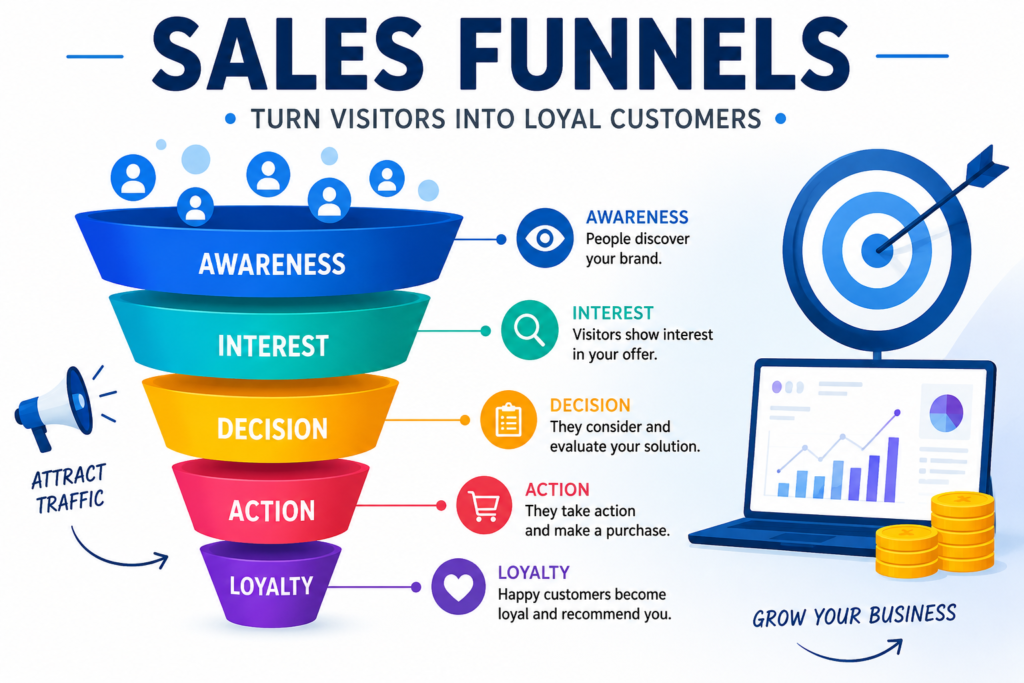
Instead of sending visitors to a generic website and hoping they buy something, a funnel gives them a clear path to follow.
A typical funnel can look like this:
Traffic → Landing Page → Lead Capture → Sales Page → Checkout → Upsell → Thank You Page
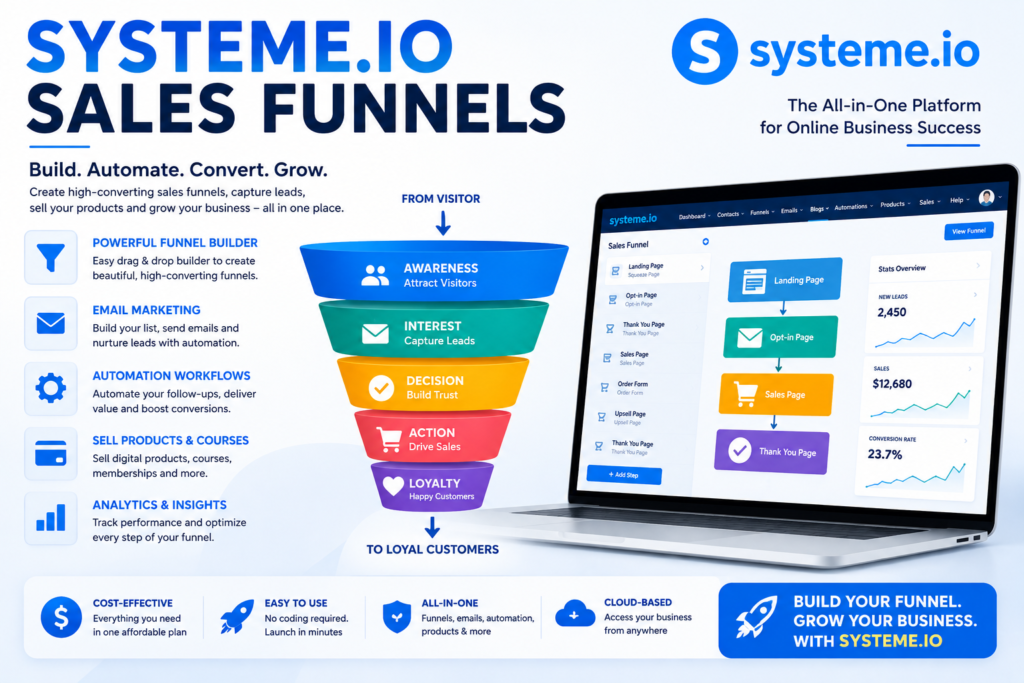
Systeme.io combines these funnel components inside one platform. Its funnel builder uses a drag-and-drop editor, while email marketing, checkout, automation, courses, and other business tools can be connected to the same funnel.
This makes Systeme.io particularly useful for entrepreneurs, affiliate marketers, coaches, consultants, course creators, and small businesses that want to build and manage funnels without connecting numerous separate marketing tools.
Why Use Systeme.io for Sales Funnels?
Building a sales funnel traditionally requires several different services.
You might need:
- A landing page builder
- An email marketing platform
- A payment processor
- A checkout system
- An upsell tool
- A course or membership platform
- Analytics software
- Automation tools
Managing all these services can become expensive and technically complicated.
Systeme.io takes an all-in-one approach. Its funnel builder is connected with email marketing, payment functionality, automation, courses, memberships, and other features.
1. Drag-and-Drop Funnel Builder
You can create funnel pages without needing to write code. Systeme.io provides templates and a visual editor that allow you to customize pages for your business.
You can build:
- Landing pages
- Opt-in pages
- Sales pages
- Checkout pages
- Thank-you pages
- Upsell pages
- Downsell pages
The goal is to make funnel creation accessible even if you do not have technical experience.
2. Built-In Email Marketing
Capturing an email address is only the beginning of many funnels.
Once someone subscribes, you can use automated emails to:
- Deliver a lead magnet
- Welcome new subscribers
- Educate prospects
- Handle objections
- Promote products
- Follow up with abandoned prospects
- Recommend additional products
Systeme.io connects email automation with funnel activity, allowing different actions to trigger follow-up sequences.
3. Checkout, Order Bumps and Upsells
A good funnel does not necessarily end after the first purchase.
You can increase the value of each customer with additional offers such as:
Main Product → Order Bump → One-Click Upsell
Systeme.io’s current feature set includes order bumps, one-click upsells and downsells, depending on the plan.
4. Funnel Analytics and A/B Testing
Getting traffic is not enough. You need to understand where visitors leave your funnel.
For example:
- High landing-page traffic + low opt-ins = improve your landing page
- High opt-ins + low sales = improve your offer or follow-up
- Good sales + low average order value = consider an upsell
- High checkout abandonment = reduce friction at checkout.
Your details are submitted securely to the site’s lead collection system.
How a Systeme.io Sales Funnel Works
Systeme.io also supports A/B testing so you can test different versions of funnel pages and determine which performs better.
A simple funnel usually contains several stages.
Step 1: Attract Visitors
The first step is bringing relevant people into your funnel.
Traffic can come from:
- Google search
- Facebook Ads
- YouTube
- TikTok
- Quora Ads
- Email marketing
- Affiliate marketing
- Blog content
- Other paid advertising platforms
The traffic source should match your target audience.
For example, someone searching for “best email marketing software” has a different buying intent from someone casually watching a marketing video.
Step 2: Send Visitors to a Landing Page
Your landing page should have one primary objective.
For a lead-generation funnel, that objective could be collecting an email address.
A strong landing page usually contains:
- A clear headline
- A compelling benefit
- Supporting copy
- Social proof
- A simple form
- A strong call-to-action
Avoid giving visitors too many competing choices.
The simpler the next step, the easier it is for visitors to understand what you want them to do.
Step 3: Capture the Lead
Instead of immediately asking every visitor to buy, you can offer something valuable in exchange for their email address.
Examples include:
- Free ebook
- Checklist
- Template
- Mini-course
- Free consultation
- Discount
- Webinar
- Free trial
This type of funnel is commonly called a lead magnet funnel.
Systeme.io’s own funnel guidance describes lead-magnet funnels as a way to capture contacts and then nurture them toward an offer through email.
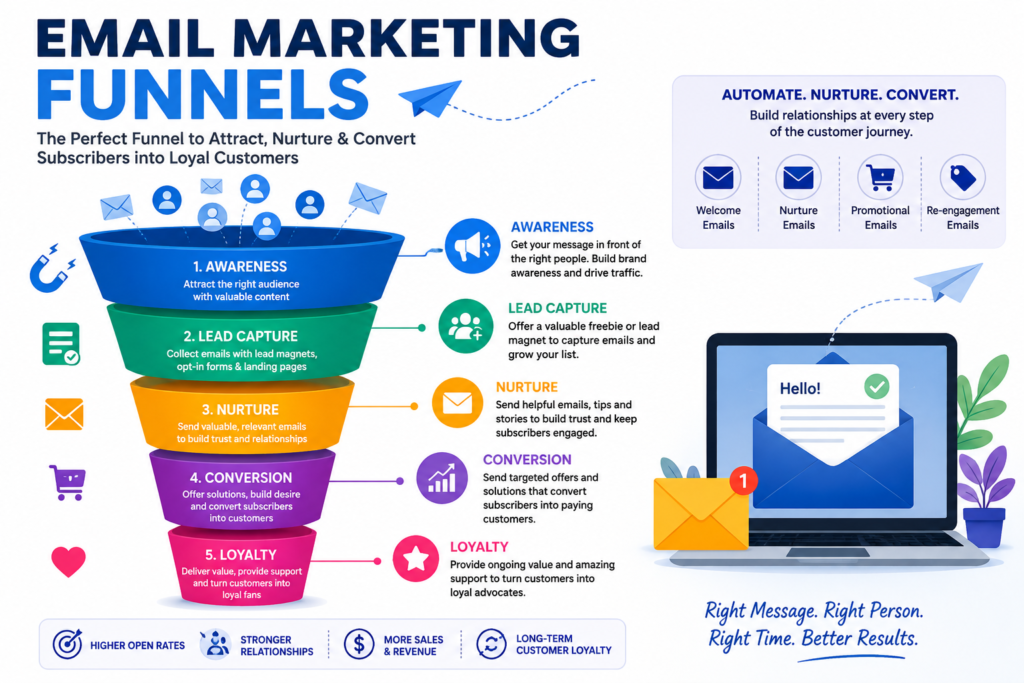
Step 4: Nurture Prospects With Email
Not everyone will buy immediately.
That’s why email follow-up can be an important part of a sales funnel.
A basic sequence might look like:
Email 1: Deliver the free resource
Email 2: Explain the problem
Email 3: Provide useful information
Email 4: Introduce the solution
Email 5: Present the offer
Email 6: Answer common objections
Email 7: Final reminder
The exact sequence should depend on the product, audience, price, and buying cycle.
Step 5: Present the Sales Offer
Once prospects understand the problem and believe your solution can help, you can direct them to a sales page.
A strong sales page should explain:
- What the product is
- Who it is for
- What problem it solves
- Key benefits
- What’s included
- Why it is different
- Testimonials or proof
- Pricing
- Guarantee, if applicable
- Frequently asked questions
- Call-to-action
The objective is not simply to make the page look attractive. It should answer the questions preventing the visitor from taking action.
Step 6: Checkout
The checkout page is where the prospect becomes a customer.
Systeme.io supports digital-product pricing structures including one-time payments, subscriptions and payment plans.
Keep checkout as simple as possible.
Unnecessary distractions, complicated forms and unexpected costs can reduce conversions.
Step 7: Increase Customer Value
After the initial purchase, you can present an additional relevant offer.
For example:
$27 Ebook → $9 Order Bump → $97 Course
The additional offer should complement the original purchase rather than simply trying to extract more money from the customer.
Step 8: Deliver the Product
After purchasing, customers should immediately know what happens next.
Your thank-you page can:
- Confirm the purchase
- Explain how to access the product
- Provide onboarding instructions
- Invite customers to a community
- Offer additional resources
- Schedule a consultation
For courses and memberships, Systeme.io can also be used to manage access to digital content.
5 Popular Systeme.io Sales Funnel Types
There is no single funnel that works for every business.
The best structure depends on your product, price and audience.
1. Lead Magnet Funnel
Structure:
Ad/SEO → Opt-in Page → Thank You Page → Email Sequence → Sales Page → Checkout
This is ideal for businesses that want to build an email list before making a sales offer.
Example:
A marketing consultant offers a free “50 Digital Marketing Ideas” PDF.
Visitors enter their email address, receive the guide and then enter an automated email sequence promoting the consultant’s service.
2. Sales Page Funnel
Structure:
Traffic → Sales Page → Checkout → Thank You Page
This is useful when the visitor already understands the product and does not require a lengthy nurturing process.
It can work particularly well for straightforward digital products and lower-priced offers.
3. Tripwire Funnel
Structure:
Traffic → Landing Page → Low-Priced Offer → Checkout → Upsell → Email Follow-Up
A tripwire funnel introduces prospects to your business with a relatively inexpensive offer.
For example:
Free Guide → $9 Product → $49 Upsell
The objective is to turn a lead into a customer and then introduce higher-value products.
4. Webinar Funnel
Structure:
Ad → Registration Page → Webinar → Offer → Checkout → Follow-Up
Webinar funnels can work well for:
- Coaching
- Consulting
- Online courses
- High-ticket services
- Business education
They provide more time to educate prospects before presenting the offer.
5. Affiliate Marketing Funnel
Affiliate marketers can also use a funnel to pre-sell an external product.
A simple structure could be:
Paid Traffic → Bridge Page → Email Capture → Affiliate Offer
For example, you might use a Systeme.io funnel to explain the problem, provide useful information, collect leads and then send interested visitors to an affiliate offer.
This approach gives you an opportunity to build your own audience rather than sending every visitor directly to an affiliate website.
Systeme.io Sales Funnel Templates
Templates can dramatically reduce the time required to build a funnel.
Instead of designing every page from scratch, you can begin with an existing structure and customize:
- Headlines
- Images
- Colors
- Fonts
- Forms
- Buttons
- Testimonials
- Pricing
- Product information
- Calls-to-action
However, remember that a beautiful template does not automatically create a high-converting funnel.
Your offer, audience, messaging and traffic quality are just as important as the design.
Systeme.io provides funnel templates intended to help users get started more quickly.
How to Create a Systeme.io Sales Funnel
Here is a practical step-by-step process.
Step 1: Define Your Goal
Start with one conversion goal.
Examples:
- Collect leads
- Sell an ebook
- Sell a course
- Book a call
- Sell coaching
- Promote an affiliate offer
- Register webinar attendees
Don’t build the funnel before knowing what action you want visitors to take.
Step 2: Define Your Target Audience
Identify:
- Who they are
- What problem they have
- What they want
- What they have already tried
- What objections they may have
- What would motivate them to take action
Step 3: Choose Your Funnel Structure
Select a funnel that matches the offer.
For example:
Low-ticket product: Sales page funnel
Audience-building: Lead magnet funnel
High-ticket coaching: Webinar or application funnel
Affiliate offer: Bridge or pre-sell funnel
Step 4: Build Your Pages
Create the required funnel steps inside Systeme.io.
Start with the minimum number of pages necessary.
For example:
Landing Page → Sales Page → Checkout → Thank You
You can add additional steps later if your data shows they are needed.
Step 5: Connect Your Email Automation
Create email sequences based on subscriber behavior.
For example:
New Subscriber → Welcome Sequence → Offer → Purchase
You can also create different follow-up paths for people who purchase and people who do not.
Step 6: Configure Your Offer
Set your price and payment structure.
Depending on your business model, this could be:
- One-time payment
- Subscription
- Payment plan
Systeme.io’s current documentation supports these digital-product pricing options.
Step 7: Add Upsells and Order Bumps
If you have complementary products, consider adding them after the main offer.
For example:
Course → Workbook Order Bump → Advanced Course Upsell
Only add offers that genuinely improve the customer’s experience.
Step 8: Test Everything
Before sending traffic, test:
- Every button
- Forms
- Checkout
- Payment process
- Emails
- Redirects
- Product delivery
- Mobile responsiveness
- Tracking
A broken funnel can waste an entire advertising budget.
How to Optimize Systeme.io Sales Funnels for More Conversions
Creating the funnel is only the beginning.
Optimization is where many businesses discover their biggest opportunities.
Improve Your Headline
Your headline should immediately communicate the primary benefit.
Instead of:
“Welcome to Our Marketing Platform”
Try:
“Build Your First High-Converting Sales Funnel Without Coding”
Focus on the outcome rather than simply describing the product.
Use One Clear CTA
Don’t confuse visitors with multiple competing actions.
Instead of:
Learn More | Contact Us | Download | Buy Now | Watch Video
focus on the most important action for that stage of the funnel.
Add Social Proof
Testimonials, reviews, case studies and demonstrations can reduce uncertainty.
Use genuine proof whenever possible.
Reduce Friction
Make forms and checkout pages as simple as possible.
Every unnecessary field or confusing step can create another opportunity for someone to leave.
Test Different Versions
Don’t assume your first version is perfect.
Test:
- Headlines
- CTA text
- Images
- Pricing presentation
- Page layout
- Forms
- Offers
Systeme.io includes A/B testing among its available funnel features.
Systeme.io Sales Funnel Metrics to Track
A funnel should be measured at every stage.
Important metrics include:
Landing Page Conversion Rate
How many visitors become leads?
Formula:
Leads ÷ Visitors × 100
Sales Conversion Rate
How many visitors become customers?
Formula:
Customers ÷ Visitors × 100
Cost Per Lead
How much does it cost to acquire one lead?
Formula:
Advertising Spend ÷ Number of Leads
Customer Acquisition Cost
How much does it cost to acquire one customer?
Formula:
Total Marketing Cost ÷ New Customers
Average Order Value
How much does the average customer spend?
Increasing average order value can make paid advertising more profitable without necessarily requiring more traffic.
Return on Ad Spend
For paid traffic, monitor:
Revenue ÷ Advertising Spend
For example, $500 in revenue from $250 in advertising spend gives a 2x ROAS.
Systeme.io Sales Funnels for Affiliate Marketing
Systeme.io can also be useful for affiliate marketers.
Instead of sending paid traffic directly to an affiliate link, you can create a bridge funnel.
For example:
Facebook Ad → Bridge Page → Email Capture → Affiliate Offer
The bridge page can explain:
- The visitor’s problem
- Why the problem matters
- What they should look for in a solution
- Why the recommended solution may be worth considering
- What they should do next
You can then follow up with email content, provided your traffic source and email practices comply with applicable rules and platform policies.
For affiliate marketers, the major advantage is that the funnel can help create an audience asset instead of relying entirely on a third-party merchant page.
How Much Does Systeme.io Cost?
Systeme.io currently offers a free plan along with paid plans. Its pricing page currently lists Free at $0/month, Startup at $27/month, Webinar at $47/month, and Unlimited at $97/month for the displayed monthly billing option. Features and limits vary by plan, so check the current pricing page before choosing a subscription.
The free plan can be useful for beginners who want to experiment with funnel building before committing to a paid subscription.
Systeme.io Sales Funnels vs. Traditional Website
A traditional website and a sales funnel serve different purposes.
| Traditional Website | Sales Funnel |
|---|---|
| Many navigation options | Focused path |
| Multiple objectives | Usually one primary objective |
| Good for information | Designed around conversion |
| Visitors explore | Visitors follow a sequence |
| Useful for branding | Useful for campaigns and sales |
You don’t necessarily have to choose one.
A business can use a website for branding and SEO while using dedicated sales funnels for advertising campaigns, lead generation and product sales.
Common Systeme.io Funnel Mistakes
Mistake 1: Sending Cold Traffic Directly to a Sales Page
Cold visitors may not know or trust your brand yet.
A lead magnet or educational bridge page may be more appropriate.
Mistake 2: Trying to Sell Too Many Products
One funnel should generally have one primary objective.
Too many offers can create confusion.
Mistake 3: Ignoring Email Follow-Up
Many visitors will not purchase during their first visit.
Email automation can give you additional opportunities to educate and convert them.
Mistake 4: Focusing Only on Design
A visually impressive funnel can still produce poor results.
Conversion depends on factors such as:
Traffic + Audience + Offer + Messaging + Trust + Funnel Experience
Mistake 5: Not Testing the Funnel
Never assume your funnel works simply because the pages look correct.
Go through the entire customer journey yourself before launching paid traffic.
Frequently Asked Questions About Systeme.io Sales Funnels
What is a Systeme.io sales funnel?
A Systeme.io sales funnel is a sequence of pages and automated marketing steps designed to move visitors from initial contact toward a specific action, such as submitting their email address or purchasing a product.
Is Systeme.io good for beginners?
Yes. The platform is designed around a visual funnel-building experience and combines multiple marketing functions in one account, which can reduce the technical complexity of building a funnel.
Can I build a sales funnel for free with Systeme.io?
Systeme.io currently offers a free plan. The exact number of funnels, steps, contacts and other features available depends on the current plan limits.
Can I sell digital products with Systeme.io?
Yes. Systeme.io supports digital products and pricing options such as one-time payments, subscriptions and payment plans.
Can I use Systeme.io for affiliate marketing?
Yes. You can use its funnel-building and email capabilities to create a marketing funnel around an affiliate offer. However, you should follow the rules of the affiliate program and the advertising platform you use.
What is the best Systeme.io funnel for beginners?
A simple lead magnet funnel is a strong starting point:
Traffic → Opt-in Page → Thank You Page → Email Sequence → Offer
It lets you build an email list while learning how each stage of a funnel performs.
Can Systeme.io replace a website?
For some businesses, it can provide many of the functions they need. However, a traditional website and a funnel have different purposes. A website can support broader content, navigation and SEO, while a funnel focuses on a specific conversion objective.
Systeme.io sales funnels provide a practical way to build, automate and manage an online sales process without assembling a large collection of separate marketing tools.
You can create a simple lead-generation funnel or build a more advanced system containing landing pages, email automation, checkout, order bumps, upsells, courses and other components.
The most important lesson is that the software alone does not make a funnel successful.
Your results will depend on the combination of:
The right audience + the right offer + strong messaging + qualified traffic + a well-designed funnel + continuous testing.
If you’re new to funnel marketing, start small. Build one funnel around one audience and one offer, measure every step, and improve the weakest stage before adding more complexity.
That approach is usually much more effective than building a complicated funnel before you know what your audience actually responds to.