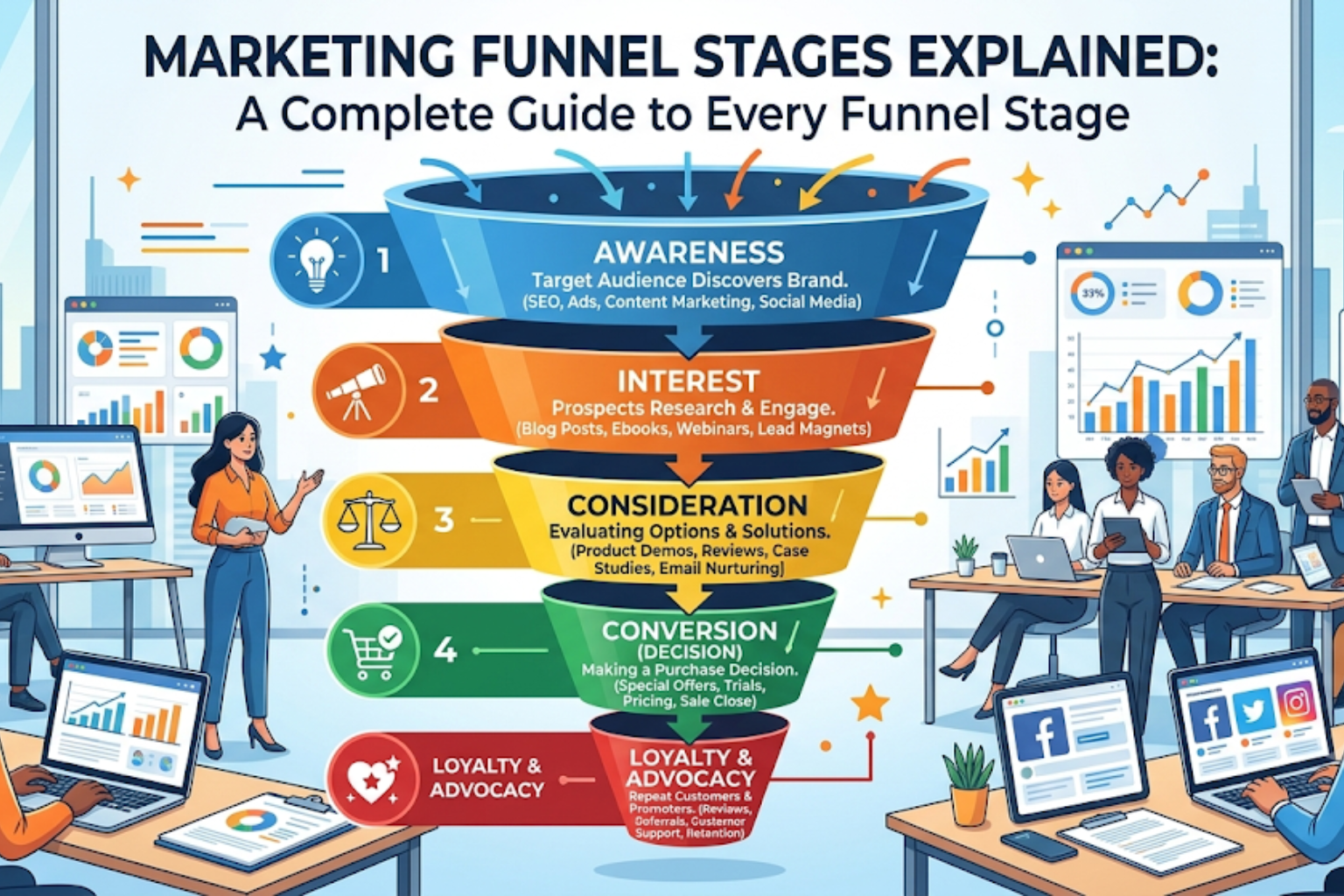

Understanding the marketing funnel stages helps us see how potential customers move from discovering a business to becoming paying customers and, eventually, loyal advocates. A marketing funnel provides a structured view of the customer journey and helps us create the right marketing message for people at different levels of awareness and buying intent.
Not every person who discovers a brand is ready to purchase immediately. Some people are simply researching a problem, others are comparing solutions, and some are actively looking for a product they can buy today. A successful marketing funnel recognizes these differences and provides relevant content, communication, and offers at every stage.
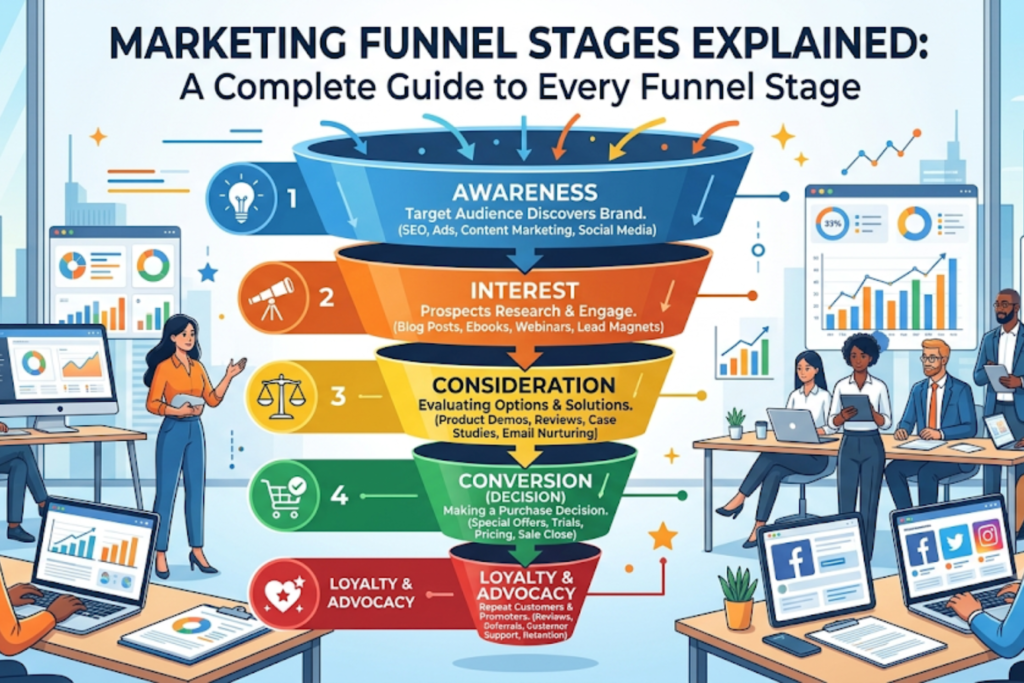
The traditional marketing funnel is often divided into Awareness, Interest, Consideration, Conversion, Retention, and Advocacy. Together, these stages create a complete customer journey.
What Are the Marketing Funnel Stages?
The marketing funnel stages describe the progression a potential customer makes as they become familiar with a business, develop interest, evaluate available solutions, make a purchase, and develop a relationship with the brand.
A simple marketing funnel can be represented as:
Awareness → Interest → Consideration → Conversion → Retention → Advocacy
The funnel is wider at the beginning because businesses generally reach a large number of people. As prospects move forward, the audience becomes smaller but more qualified.
For example, thousands of people may see an advertisement, hundreds may visit a website, dozens may become leads, and a smaller percentage may eventually purchase.
The objective is not simply to push everyone toward a sale. Instead, we focus on guiding the right prospects through the customer journey.
Stage 1: Awareness
The first marketing funnel stage is awareness.
At this stage, people are discovering a business, product, service, or solution for the first time. They may not know the brand and may not even realize that a particular solution exists.
Our primary objective is to attract the attention of the right audience.
Common awareness channels include:
- Search engines
- Blog posts
- Social media
- YouTube videos
- Paid advertising
- Podcasts
- Influencer marketing
- Online communities
- Educational content
- Display advertising
For example, someone searching for “how to build an online sales funnel” may discover a blog article that explains marketing funnels.
The person has not necessarily decided to buy anything. They are simply looking for information.
That makes educational content particularly valuable at the awareness stage.
What Content Works at the Awareness Stage?
We can use content such as:
- Beginner guides
- Educational blog posts
- How-to articles
- Videos
- Infographics
- Social media posts
- Free educational resources
- Search-optimized content
The goal is to provide value while introducing the audience to the brand.
Stage 2: Interest
After awareness comes interest.
At this point, prospects recognize that they have a problem, need, or goal and begin actively learning about possible solutions.
They may visit additional pages, subscribe to an email list, follow a social media account, watch product videos, or download a resource.
Our goal is to turn general awareness into meaningful engagement.
For example, a visitor reading an article about marketing funnels might download a free funnel-building checklist.
The visitor has now taken an additional action, which indicates greater interest.
How to Generate Interest
Useful strategies include:
- Lead magnets
- Free guides
- Checklists
- Webinars
- Email newsletters
- Free courses
- Quizzes
- Tutorials
- Product demonstrations
- Educational videos
A lead magnet can be particularly effective because it provides immediate value in exchange for contact information.
Once a prospect becomes a lead, we can continue providing relevant information instead of depending entirely on them to return to the website.
Stage 3: Consideration
The consideration stage is where prospects begin evaluating specific solutions.
They understand their problem and know that products or services exist that could help them. Now they want to determine which option is best.
At this stage, prospects may search for:
- Product reviews
- Software comparisons
- Pricing
- Alternatives
- Features
- Customer testimonials
- Case studies
- Product demonstrations
For example, someone looking for funnel software might search for “best marketing funnel software for beginners” or compare different funnel-building platforms.
This is an important stage because prospects are moving closer to a purchasing decision.
Content for the Consideration Stage
We can use:
- Product comparisons
- Reviews
- Case studies
- Testimonials
- Demonstrations
- Detailed guides
- FAQs
- Feature comparisons
- Pricing information
- Free trials
The key objective is to reduce uncertainty and demonstrate value.
Prospects should be able to understand how the product works, what problem it solves, who it is suitable for, and why it may be a better choice than competing alternatives.
Stage 4: Conversion
The conversion stage is where a prospect takes the desired action.
For many businesses, conversion means making a purchase. However, conversion can also mean booking a consultation, starting a free trial, requesting a quote, signing up for a service, or completing another valuable action.
At this stage, the prospect is already relatively familiar with the solution. The marketing experience should therefore make the final decision as easy as possible.
What Helps Increase Conversion Rates?
We can improve conversion opportunities by using:
- Clear calls-to-action
- Strong value propositions
- Customer testimonials
- Reviews
- Transparent pricing
- Product benefits
- Guarantees where appropriate
- Simple checkout processes
- Free trials
- Demonstrations
- Frequently asked questions
A strong call-to-action should clearly communicate what happens next.
For example:
Start Your Free Trial
is more specific than a generic button such as Click Here.
The landing page and checkout process should also avoid unnecessary distractions.
Stage 5: Retention
A common mistake is to assume that the marketing funnel ends after a purchase.
In reality, retention is one of the most important marketing funnel stages.
Once someone becomes a customer, our objective changes from convincing them to purchase toward helping them receive ongoing value from their purchase.
A satisfied customer may make additional purchases, renew a subscription, upgrade to a higher plan, or continue using a service for a longer period.
Retention Strategies
We can improve customer retention through:
- Onboarding emails
- Tutorials
- Customer support
- Educational content
- Loyalty programs
- Personalized recommendations
- Product updates
- Exclusive offers
- Customer communities
- Follow-up campaigns
For example, software companies can send new customers a series of onboarding emails explaining how to set up their account and use important features.
The faster customers achieve a useful result, the stronger the opportunity for long-term retention.
Stage 6: Advocacy
The final stage is advocacy.
At this point, satisfied customers can become promoters of the business.
They may leave reviews, recommend the product to friends, create social media content, participate in referral programs, or recommend the brand to colleagues.
Customer advocacy is valuable because recommendations from existing customers can generate new awareness.
How to Encourage Customer Advocacy
Businesses can encourage advocacy through:
- Referral programs
- Affiliate programs
- Customer testimonials
- Review requests
- Case studies
- Referral incentives
- User-generated content
- Social media campaigns
- Customer communities
When customers have a genuinely positive experience, they are more likely to share that experience with others.
This can create a cycle where existing customers help generate new prospects, bringing new people into the awareness stage.
Marketing Funnel Stages Example
Let’s consider an example of an online course business.
First, someone discovers a blog post titled “How to Create a Marketing Funnel for Beginners.”
This represents the awareness stage.
The visitor then downloads a free marketing funnel checklist.
This demonstrates interest.
After receiving several educational emails, the person begins researching different funnel-building solutions.
This represents the consideration stage.
The business presents an online course that teaches people how to create and optimize funnels. The prospect reviews the course information and decides to purchase.
This is the conversion stage.
After purchasing, the customer receives onboarding instructions, tutorials, and additional educational resources.
This supports retention.
Finally, the satisfied customer recommends the course to another entrepreneur and leaves a positive review.
This represents advocacy.
The example demonstrates how the different marketing funnel stages work together rather than functioning as isolated marketing activities.
How Email Marketing Supports Every Funnel Stage
Email marketing can play an important role throughout the funnel.
At the awareness and interest stages, email can deliver educational content and valuable resources.
During consideration, emails can provide comparisons, case studies, product information, and answers to common objections.
During conversion, email can communicate offers, reminders, product benefits, and relevant calls-to-action.
After a purchase, email can support onboarding, customer education, retention, and referrals.
A basic email funnel might look like:
Lead Magnet → Welcome Email → Educational Content → Product Introduction → Offer → Follow-Up → Customer Onboarding
The exact sequence depends on the business model and customer journey.
Marketing Funnel Stages and Customer Intent
One of the most important principles of funnel marketing is understanding customer intent.
Someone searching “what is a marketing funnel?” is usually at a different stage from someone searching “marketing funnel software pricing.”
The first person may need education.
The second person may already be evaluating a purchase.
Therefore, we should create content that matches the searcher’s intent.
For example:
Informational Intent:
“What is a marketing funnel?”
Educational Intent:
“How to create a marketing funnel”
Commercial Investigation:
“Best marketing funnel software”
Transactional Intent:
“Marketing funnel software pricing”
Matching content with intent can create a more relevant customer experience.
How to Optimize Each Marketing Funnel Stage
We can improve funnel performance by analyzing each stage separately.
If awareness traffic is low, we may need to improve content distribution, SEO, advertising, or audience targeting.
If traffic is high but few visitors become leads, we may need to improve the landing page or lead magnet.
If leads are increasing but sales remain low, we may need to improve lead nurturing, product positioning, pricing, trust signals, or the sales offer.
If customers purchase but do not return, we may need to improve onboarding, customer support, and retention strategies.
This approach allows us to identify where prospects are dropping out of the funnel and make targeted improvements.
Common Marketing Funnel Mistakes
Trying to Sell Too Early
Not every visitor is ready to buy. Educational content can help prospects move toward a purchasing decision naturally.
Ignoring Existing Customers
Customer retention can be just as important as customer acquisition. We should continue delivering value after conversion.
Using the Same Content for Every Stage
Awareness content and conversion content have different purposes. We should match the message to the prospect’s intent.
Creating Too Many Steps
A complicated funnel can create unnecessary friction. Every step should have a clear purpose.
Not Tracking Results
Without metrics, it becomes difficult to determine where the funnel needs improvement.
Important Marketing Funnel Metrics
We can monitor different metrics at different stages.
For awareness:
- Website traffic
- Impressions
- Reach
- Search visibility
- Video views
For interest:
- Lead generation
- Landing page conversion rate
- Email subscriptions
- Content engagement
For consideration:
- Product page visits
- Demo requests
- Trial registrations
- Comparison page engagement
For conversion:
- Sales
- Conversion rate
- Revenue
- Average order value
- Customer acquisition cost
For retention:
- Repeat purchases
- Subscription renewals
- Customer lifetime value
- Churn rate
For advocacy:
- Referrals
- Reviews
- Testimonials
- Affiliate sales
- User-generated content
Tracking these metrics gives us a clearer picture of how the entire funnel performs.
Final Thoughts on Marketing Funnel Stages
The marketing funnel stages provide a practical framework for understanding how people move from discovering a business to becoming loyal customers.
The six major stages are:
Awareness → Interest → Consideration → Conversion → Retention → Advocacy
Each stage has a different purpose. Awareness attracts potential customers, interest encourages engagement, consideration builds confidence, conversion turns prospects into customers, retention develops long-term relationships, and advocacy encourages satisfied customers to promote the business.
A successful funnel does not depend on aggressively selling at every stage. Instead, it focuses on understanding customer needs, delivering relevant value, building trust, and making the next step clear.
Whether we are marketing software, services, online courses, ecommerce products, or affiliate offers, understanding these stages helps us create a more organized and effective customer journey.
When each stage is connected properly, the marketing funnel becomes more than a diagram. It becomes a repeatable system for attracting prospects, generating leads, increasing conversions, retaining customers, and creating long-term business growth.