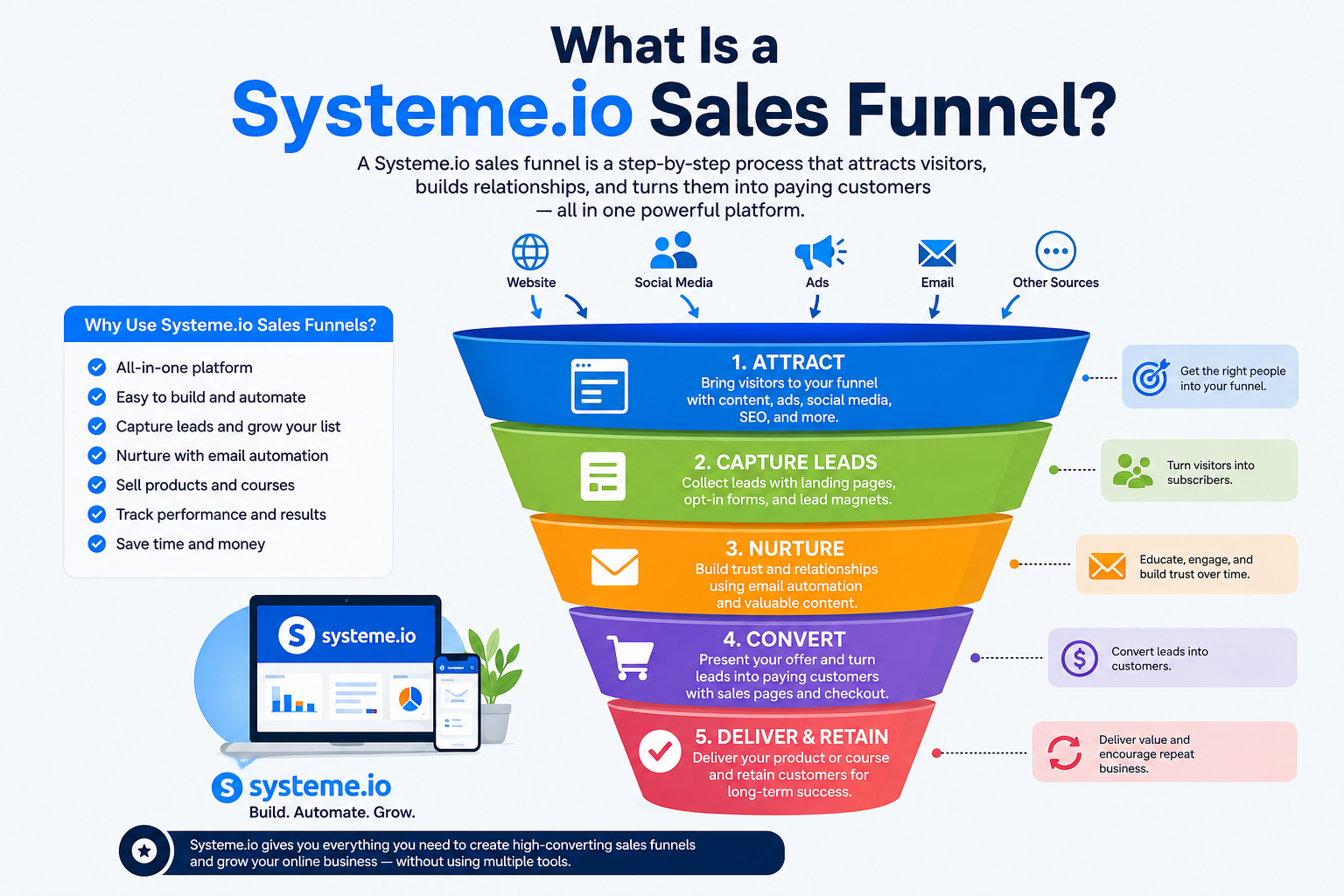

A Systeme.io sales funnel is a complete online marketing and sales system designed to guide potential customers from their first interaction with a business to a final purchase. Instead of relying on multiple disconnected tools for landing pages, email marketing, automation, payment processing, and customer management, we can use Systeme.io to bring many of these functions together in one platform.
For businesses, entrepreneurs, coaches, consultants, course creators, affiliate marketers, and digital product sellers, a well-designed Systeme.io sales funnel can simplify the process of attracting visitors, collecting leads, building relationships, and converting prospects into paying customers.
A sales funnel is essentially the journey a prospect takes before becoming a customer. Systeme.io provides the tools needed to create and automate many stages of that journey.
What Is a Sales Funnel?
Before understanding a Systeme.io sales funnel, we should understand the concept of a sales funnel.
A sales funnel represents the different stages a potential customer moves through before making a purchase. A typical funnel begins with awareness and gradually moves toward interest, consideration, conversion, and customer retention.
For example, imagine we are selling an online marketing course.
A potential customer may first discover our website through Google, social media, an advertisement, or another website. Instead of immediately asking that visitor to purchase an expensive course, we can offer something valuable for free, such as an ebook or checklist.
The visitor provides an email address to receive the free resource. We can then use email marketing to educate the prospect, demonstrate the value of our product, answer common questions, and eventually present an offer.
This entire process can be structured as a sales funnel.
What Is a Systeme.io Sales Funnel?
A Systeme.io sales funnel is a funnel created using the sales and marketing tools available inside Systeme.io.
The platform allows us to build funnel pages, collect leads, send automated emails, sell products, accept payments, create offers, and manage other parts of the customer journey from one central system.
A simple Systeme.io funnel might look like this:
Traffic → Landing Page → Lead Capture → Thank-You Page → Email Follow-Up → Sales Page → Checkout → Purchase
The exact structure depends on the business model and marketing objective.
For example, an affiliate marketer may create a lead-generation funnel, while a course creator may create a webinar funnel or product sales funnel.
The important idea is that each step has a specific purpose and moves the prospect closer to the desired action.
How Does a Systeme.io Sales Funnel Work?
A Systeme.io funnel generally works by connecting multiple marketing steps together.
1. Attract Visitors
The first step is getting people into the funnel.
Traffic can come from several sources, including:
- Google search
- YouTube
- Paid advertising
- Email marketing
- Blog content
- Affiliate traffic
- Online communities
- Referral traffic
The traffic source is important because the people entering the funnel should be relevant to the offer.
For example, if we sell an email marketing course, attracting people who are interested in email marketing is generally more useful than sending completely unrelated visitors to the funnel.
2. Create a Landing Page
Once visitors arrive, we can send them to a Systeme.io landing page.
A landing page is designed around one primary objective. Depending on the funnel, that objective might be collecting an email address, registering for a webinar, downloading a free resource, or purchasing a product.
An effective landing page usually contains:
- A clear headline
- Supporting text
- Benefits of the offer
- Relevant images or graphics
- Social proof when available
- A strong call to action
- A simple form or button
The page should make it immediately clear what the visitor should do next.
3. Capture Leads
One of the most useful applications of a sales funnel is lead generation.
Instead of allowing visitors to leave the website without taking action, we can offer something valuable in exchange for their contact information.
This could include:
- Free ebook
- Checklist
- Template
- Mini-course
- Webinar
- Free training
- Discount
- Consultation
- Free report
The visitor enters their information through the funnel page, and the lead can then be added to the appropriate marketing workflow.
This transforms an anonymous website visitor into a potential customer we can continue communicating with.
Systeme.io Email Marketing and Automation
Email automation is an important part of many Systeme.io sales funnels.
After someone becomes a lead, we can create an automated email sequence designed to build trust and move that person toward an offer.
For example, a simple sequence could look like this:
Email 1: Deliver the free resource
Email 2: Introduce the problem
Email 3: Provide useful advice
Email 4: Explain a solution
Email 5: Introduce the product
Email 6: Address objections
Email 7: Present a final call to action
The objective is not simply to send promotional emails. A strong sequence should provide useful information while gradually helping prospects understand why the product or service may be appropriate for them.
Automation can also help us send different messages based on customer actions.
For example, someone who purchases a product should not continue receiving the same promotional sequence designed for people who have not purchased.
Systeme.io Sales Pages
Once prospects understand the value of an offer, we can direct them to a sales page.
A sales page provides more detailed information about the product or service.
A well-structured sales page may include:
- A compelling headline
- The main customer problem
- The proposed solution
- Product benefits
- Features
- How the product works
- Testimonials
- Frequently asked questions
- Pricing
- Guarantee information where applicable
- Call-to-action buttons
The goal is to remove uncertainty and help qualified prospects make an informed purchasing decision.
Systeme.io Checkout Pages
For products that are sold directly through the funnel, the checkout page is another important stage.
The checkout process should be straightforward and focused. Too many unnecessary steps can create friction and increase the possibility that a prospect abandons the purchase.
Depending on the business model, the funnel can lead customers from the sales page to the checkout process and then to a confirmation or thank-you page.
This creates a connected customer journey instead of requiring the customer to navigate between multiple unrelated systems.
Systeme.io Thank-You Pages
After a visitor completes an action, we can send them to a thank-you page.
The purpose of this page depends on the funnel.
For a lead magnet funnel, it could explain how to access the free resource.
For a webinar funnel, it could provide event details.
For a product funnel, it could confirm the purchase and explain the next steps.
A thank-you page can also be used strategically to introduce another relevant offer, encourage social media engagement, or provide additional instructions.
Different Types of Systeme.io Sales Funnels
There is no single funnel structure that works for every business.
Lead Generation Funnel
A lead generation funnel focuses on collecting contact information from potential customers.
A common structure is:
Landing Page → Opt-In Form → Thank-You Page → Email Sequence
This type of funnel works particularly well when the prospect needs more information before purchasing.
Product Sales Funnel
A product sales funnel is designed to generate direct purchases.
A basic structure could be:
Landing Page → Sales Page → Checkout → Thank-You Page
This is useful for digital products, courses, templates, memberships, and other online offers.
Webinar Funnel
A webinar funnel is designed to attract people to a live or automated presentation.
A typical structure could be:
Registration Page → Confirmation Page → Reminder Emails → Webinar → Offer → Checkout
Webinars can be particularly useful for products that require education before purchase.
Course Funnel
Online course creators can use a funnel to attract students, capture leads, introduce their educational product, and complete enrollment.
For example:
Free Training → Email Sequence → Course Sales Page → Checkout → Course Access
This structure allows the business to educate prospects before presenting the paid course.
Affiliate Marketing Funnel
Affiliate marketers can also use sales funnels to build their own audience before sending qualified prospects to an affiliate offer.
For example:
Advertisement → Lead Magnet → Opt-In → Email Sequence → Affiliate Recommendation
Instead of sending paid traffic directly to an affiliate offer, the marketer can first build a relationship with the prospect.
Why Use Systeme.io for Sales Funnels?
One of the main advantages of Systeme.io is the ability to manage multiple marketing functions within one platform.
A traditional marketing setup might require separate services for:
- Landing pages
- Email marketing
- Automation
- Online courses
- Checkout
- Payment processing
- Affiliate management
- Customer management
Using an integrated platform can make funnel management simpler because the different components can work together.
For beginners, this can also reduce the technical complexity involved in connecting multiple marketing applications.
How to Create a Systeme.io Sales Funnel
Creating a funnel should begin with the business objective rather than the page design.
Step 1: Define the Goal
First, decide what the funnel needs to accomplish.
The goal could be:
- Generate leads
- Sell a product
- Book consultations
- Register webinar attendees
- Promote an affiliate product
- Sell an online course
- Build an email list
A clear objective makes it easier to choose the appropriate funnel structure.
Step 2: Identify the Target Audience
We should define who the funnel is intended for.
Consider:
- What problem does the audience have?
- What result do they want?
- What objections might prevent them from buying?
- What information do they need before making a decision?
- What type of offer would be valuable to them?
The better we understand the audience, the easier it becomes to create relevant messaging.
Step 3: Choose the Offer
The offer is the core of the funnel.
It could be a:
- Digital product
- Online course
- Membership
- Coaching program
- Software product
- Service
- Ebook
- Affiliate product
The funnel should be designed around the offer rather than simply creating pages without a clear purpose.
Step 4: Build the Funnel Pages
Next, we can create the necessary funnel pages.
Depending on the funnel, these may include:
Opt-in page → Thank-you page → Sales page → Checkout → Confirmation page
Not every funnel requires every page.
Step 5: Create the Email Automation
After the funnel pages are connected, we can create an email sequence.
The sequence should provide value, establish credibility, explain the problem, present the solution, and encourage the appropriate next action.
Step 6: Test the Funnel
Before sending visitors to the funnel, every step should be tested.
We should verify:
- Forms work correctly
- Emails are delivered
- Links work
- Buttons go to the correct pages
- Checkout works properly
- Mobile pages display correctly
- Thank-you pages load correctly
- Automation triggers correctly
A small technical problem can negatively affect the entire customer journey.
Systeme.io Sales Funnel Example
Consider an entrepreneur selling a $49 digital marketing ebook.
The funnel could work like this:
Step 1: A visitor sees a Facebook advertisement.
Step 2: The advertisement sends the visitor to a landing page offering a free marketing checklist.
Step 3: The visitor enters an email address.
Step 4: The visitor receives the checklist.
Step 5: An automated email sequence provides useful marketing advice.
Step 6: The emails introduce the paid ebook.
Step 7: The prospect clicks the sales-page link.
Step 8: The prospect reviews the offer.
Step 9: The prospect purchases the ebook through the checkout page.
Step 10: The customer receives confirmation and access instructions.
This is a simple example, but it demonstrates how a Systeme.io sales funnel can connect traffic, lead generation, email marketing, sales, and customer delivery into one journey.
How to Improve a Systeme.io Sales Funnel
Building the funnel is only the beginning. We should continuously evaluate its performance.
Important metrics can include:
- Landing page conversion rate
- Lead conversion rate
- Email open rate
- Email click-through rate
- Sales conversion rate
- Cost per lead
- Customer acquisition cost
- Average order value
- Revenue per visitor
If many people visit the landing page but few become leads, the opt-in page may need improvement.
If many people become leads but few purchase, the problem may be related to the email sequence, offer, pricing, sales page, or audience targeting.
This approach allows us to improve individual stages instead of changing the entire funnel without knowing what is causing the problem.
Common Systeme.io Sales Funnel Mistakes
Using Too Many Steps
A funnel should have enough steps to educate and convert prospects, but unnecessary complexity can make the customer journey confusing.
Weak Headlines
The headline is often one of the first elements a visitor sees. It should communicate the primary benefit or problem clearly.
Ignoring Mobile Users
A significant amount of online traffic comes from mobile devices. Funnel pages should therefore be checked carefully on smaller screens.
Sending Unqualified Traffic
A beautifully designed funnel cannot compensate for traffic that has little interest in the offer.
Audience targeting and message consistency are essential.
Not Following Up
Many visitors will not purchase during their first interaction with a business.
Email follow-up gives us an opportunity to continue educating prospects and bring interested visitors back to the offer.
Not Testing the Funnel
Broken forms, incorrect links, missing emails, or checkout problems can undermine an otherwise strong funnel.
Testing should be part of the funnel-building process.
Systeme.io Sales Funnel vs. Traditional Website
A traditional website usually contains multiple pages and allows visitors to explore different sections.
A sales funnel, on the other hand, is designed around a specific customer journey.
For example, a website might allow visitors to browse:
Home → About → Blog → Services → Contact
A focused sales funnel might guide them through:
Advertisement → Landing Page → Lead Magnet → Email Sequence → Sales Page → Checkout
Both can be valuable.
A website is often useful for establishing a broader online presence, while a sales funnel can provide a more focused path toward a specific conversion goal.
Is a Systeme.io Sales Funnel Good for Beginners?
A Systeme.io sales funnel can be useful for beginners because the basic concept is straightforward: attract the right people, provide value, capture leads, communicate with prospects, and present a relevant offer.
The most important part is not creating dozens of pages. It is understanding the customer journey.
A beginner can start with a relatively simple funnel:
Traffic → Landing Page → Email Capture → Email Sequence → Offer
Once that funnel works consistently, additional elements can be introduced where they provide a genuine benefit.
A Systeme.io sales funnel is a structured customer journey that can combine landing pages, lead capture, email marketing, automation, sales pages, checkout, and other marketing functions into one connected process.
The real value of a funnel comes from how strategically each stage works together.
A successful funnel does not simply push visitors toward a purchase. It helps the right audience understand a problem, discover a solution, develop confidence in the offer, and take the next appropriate action.
For entrepreneurs, course creators, affiliate marketers, coaches, consultants, and online businesses, Systeme.io can provide a practical environment for building and managing this process.
The best approach is to start with a clear audience, a valuable offer, and a simple customer journey. From there, we can measure performance, identify weak points, and continuously improve the funnel.
When each stage has a clear purpose, a Systeme.io sales funnel can become an important part of a scalable online marketing strategy.