
We can spend money on advertising, attract hundreds or thousands of visitors, and still wonder why our sales funnel is not converting. This is one of the most common problems faced by marketers, online businesses, coaches, agencies, SaaS companies, and digital product creators.
A sales funnel can receive plenty of traffic without generating enough leads or customers. The problem may be the audience, landing page, offer, messaging, pricing, checkout process, trust level, or follow-up strategy.
The good news is that a poorly converting funnel can usually be improved once we identify where potential customers are dropping out.
Instead of assuming that we simply need more traffic, we should examine every stage of the customer journey and determine what is preventing visitors from taking the next step.
What Does It Mean When a Sales Funnel Is Not Converting?
A sales funnel is not converting when visitors enter the funnel but fail to complete the action we want them to take.
That action depends on the purpose of the funnel. We may want visitors to:
- Submit a lead form
- Subscribe to an email list
- Start a free trial
- Book a consultation
- Download a resource
- Register for a webinar
- Purchase a product
- Upgrade to a paid plan
- Schedule a sales call
For example, suppose our landing page receives 1,000 visitors but only 10 people purchase. The funnel has generated traffic, but its conversion rate is only 1%.
Rather than immediately buying more advertising, we should investigate what happens between the first click and the final purchase.
The key question is not simply “Why aren’t people buying?”
The better question is:
“At which stage are potential customers leaving the funnel, and why?”
Once we know the answer, optimization becomes much easier.
1. We Are Targeting the Wrong Audience
One of the biggest reasons a sales funnel fails to convert is poor audience targeting.
We can have an excellent landing page, professional design, persuasive copy, and an attractive offer, but none of these elements can compensate for sending the wrong people into the funnel.
Imagine that we are selling accounting software designed specifically for small businesses. If we advertise to anyone interested in business, we may receive plenty of clicks from students, employees, large corporations, freelancers, or people who have no immediate need for accounting software.
The traffic numbers may look impressive, but the conversion rate can remain extremely low.
We should therefore define our ideal customer before optimizing the funnel.
We need to understand:
- What type of customer needs our product?
- What problem are they experiencing?
- What solution are they currently using?
- What motivates them to search for an alternative?
- What objections prevent them from purchasing?
- How urgent is their problem?
- What characteristics indicate strong buying intent?
When our advertising reaches people who genuinely need the solution, every stage of the funnel becomes easier to optimize.
2. The Advertisement and Landing Page Do Not Match
Another common reason for poor funnel conversion is message mismatch.
Suppose our advertisement says:
“Create a Professional Website Without Coding.”
The user clicks the advertisement expecting to learn about a simple website-building solution.
However, the landing page headline says:
“Welcome to Our Platform.”
The visitor now has to figure out whether they are in the right place.
This creates friction.
Our advertising message and landing page should be consistent.
The customer journey should feel like:
Advertisement → Landing Page → Offer → Checkout
If the advertisement promises a specific benefit, the landing page should immediately reinforce that benefit.
For example:
Advertisement:
“Build Your First Sales Funnel Without Coding”
Landing Page:
“Build a Complete Sales Funnel Without Coding”
The closer the message matches the visitor’s expectation, the easier it becomes for them to understand the offer.
3. Our Value Proposition Is Not Strong Enough
A visitor needs to understand why our product deserves their attention.
Many sales funnels focus heavily on features while failing to communicate the actual benefit.
For example:
Weak value proposition:
“Includes email marketing, CRM, automation, landing pages, and analytics.”
This explains what the software contains but does not clearly communicate the outcome.
A stronger version could be:
“Build automated sales funnels, capture leads, and follow up with prospects from one platform.”
The second statement focuses more on what the customer can accomplish.
A strong sales funnel value proposition should quickly communicate:
- What we provide
- Who it is designed for
- What problem it solves
- What benefit the customer receives
Visitors should not have to read an entire page to understand why the offer is relevant.
4. We Are Asking for the Sale Too Early
Not every visitor is ready to buy.
Some people may have discovered our business for the first time. They may not trust the brand yet, understand the product, or believe that they need the solution.
If we immediately ask a completely cold visitor to make a purchase, conversion rates may be disappointing.
Instead, we can create different steps based on the customer’s buying stage.
For example:
Cold Traffic → Free Resource → Email Follow-Up → Educational Content → Product Demonstration → Offer → Purchase
A lead magnet can be particularly useful for turning visitors into prospects.
Examples include:
- Free ebook
- Checklist
- Template
- Free calculator
- Webinar
- Free course
- Product demo
- Free trial
- Strategy guide
The goal is to give potential customers a reason to continue the relationship instead of expecting an immediate purchase.
5. The Call-to-Action Is Confusing
A call-to-action tells visitors what they should do next.
If the CTA is unclear, visitors may hesitate or leave the page.
Generic buttons such as:
- Submit
- Click Here
- Continue
- Next
may not communicate enough value.
More specific CTAs can be more persuasive because they explain the action and its expected benefit.
Examples include:
- Start My Free Trial
- Get My Free Guide
- Create My Free Account
- Get Instant Access
- Book My Free Consultation
- Calculate My Savings
The CTA should be easy to find and directly connected to the objective of the page.
6. The Landing Page Contains Too Many Distractions
A landing page should have a clear purpose.
If visitors encounter dozens of links, buttons, pop-ups, advertisements, menus, and competing offers, they may become distracted.
We should ask whether each element on the page supports the primary conversion goal.
For a lead-generation funnel, the goal may be collecting an email address.
For a product funnel, the goal may be getting visitors to begin checkout.
For a consultation funnel, the goal may be booking an appointment.
The page should guide visitors toward that action instead of giving them too many alternative paths.
A clean and focused landing page can make it easier for visitors to understand what we want them to do.
7. The Offer Does Not Provide Enough Perceived Value
Sometimes the problem is not the landing page.
The problem is the offer itself.
A visitor may understand exactly what we are selling but still decide that it is not worth the price.
We can improve perceived value by making the complete offer more useful.
Depending on the product, we might include:
- Bonuses
- Templates
- Training
- Tutorials
- Premium support
- Free trials
- Guarantees
- Additional features
- Implementation assistance
- Exclusive resources
We should not automatically reduce the price.
Instead, we should determine whether the customer clearly understands what they receive in return for their investment.
The objective is to make the perceived value of the solution significantly greater than the perceived cost.
8. We Have Not Built Enough Trust
Trust is extremely important in online sales.
Visitors may hesitate when they do not recognize our brand or do not have enough evidence that the product works.
A professional-looking website alone may not be enough.
We can strengthen credibility by including relevant proof such as:
- Customer testimonials
- Reviews
- Case studies
- Demonstrations
- Product screenshots
- Customer results
- Client logos
- Guarantees
- Clear contact information
- Transparent pricing
- Refund policies
- Frequently asked questions
Specific testimonials are generally more useful than vague praise.
For example, instead of simply saying:
“Excellent product!”
a stronger testimonial explains the customer’s problem, experience, and result.
This gives potential customers more information to evaluate the offer.
9. We Are Not Addressing Customer Objections
Potential customers often have questions before purchasing.
They may wonder:
“Is this suitable for beginners?”
“Does it work for my business?”
“Can I cancel anytime?”
“Is there a free trial?”
“Is my payment information secure?”
“What happens if I don’t like the product?”
“How difficult is the setup?”
If our sales funnel does not answer these questions, prospects may leave the page and search for information somewhere else.
A strong sales funnel anticipates these objections and addresses them before they become barriers.
An FAQ section, product demonstration, comparison table, guarantee, testimonials, and transparent pricing can all help reduce uncertainty.
10. The Checkout Process Is Too Complicated
A visitor can move through the entire funnel and decide to purchase, but we can still lose the sale during checkout.
This is known as checkout abandonment.
A complicated checkout process may require too many forms, unnecessary information, multiple pages, or account creation before purchase.
We should keep checkout as simple as possible.
The customer should be able to clearly see:
- What they are purchasing
- The total price
- Billing frequency
- Available payment methods
- Guarantee information
- Important terms
- Final purchase button
Unexpected fees can also damage trust.
If a product appears to cost $49 on the sales page but becomes $69 at checkout because of unexpected charges, the customer may abandon the purchase.
Transparency throughout the buying process is essential.
11. The Funnel Is Poorly Optimized for Mobile
A large amount of online traffic comes from smartphones.
If our funnel looks excellent on a desktop but performs poorly on mobile devices, we may be losing potential customers.
We should test the entire funnel on different screen sizes.
Important areas to check include:
- Page loading speed
- Font size
- Button size
- Form fields
- Images
- Videos
- Navigation
- Pop-ups
- Checkout pages
- Payment forms
Visitors should be able to read the content and complete the desired action without zooming, horizontal scrolling, or waiting excessively for the page to load.
A mobile-friendly sales funnel is essential when a significant portion of traffic comes from smartphones.
12. We Are Generating the Wrong Type of Traffic
More traffic does not necessarily mean more sales.
Suppose we receive 20,000 visitors from a broad advertising campaign, but most of them have no interest in our product.
The traffic number looks impressive, but the business receives very few customers.
Instead of focusing only on visitor volume, we should examine traffic quality.
Important metrics include:
- Click-through rate
- Landing page conversion rate
- Lead conversion rate
- Cost per lead
- Sales conversion rate
- Customer acquisition cost
- Average order value
- Customer lifetime value
These numbers help us determine whether we have a traffic problem or a funnel problem.
If visitors are not qualified, improving the landing page alone may not solve the issue.
13. We Are Not Following Up With Leads
Many potential customers do not purchase during their first visit.
This is particularly common when the product requires consideration.
Someone may download our free guide today but not purchase until several days or weeks later.
This is why lead nurturing is an important part of many sales funnels.
A simple email sequence might include:
Email 1: Deliver the promised resource
Email 2: Explain the customer’s problem
Email 3: Provide useful education
Email 4: Introduce the solution
Email 5: Share customer proof
Email 6: Answer common objections
Email 7: Present the offer
This type of follow-up keeps our business in front of potential customers while helping them move toward a buying decision.
14. We Are Not Testing Different Funnel Elements
A funnel should not be treated as a finished project.
Even a funnel that performs reasonably well can often be improved.
We should test important elements such as:
- Headlines
- Subheadlines
- CTA text
- Images
- Videos
- Forms
- Pricing
- Testimonials
- Offers
- Page layouts
- Email subject lines
- Email content
For example, we might compare:
Version A:
“Build Your Sales Funnel in Minutes”
Version B:
“Turn More Website Visitors Into Customers”
If Version B consistently produces a better conversion rate, we have useful evidence about what matters to our audience.
Testing allows us to replace assumptions with data.
15. The Funnel Does Not Match the Customer Journey
Customers do not all enter a funnel at the same level of awareness.
Someone who has never heard of our product may need education.
Someone who already knows the product category may want to compare alternatives.
Someone who has already visited the pricing page may simply need reassurance before purchasing.
A useful customer journey can look like:
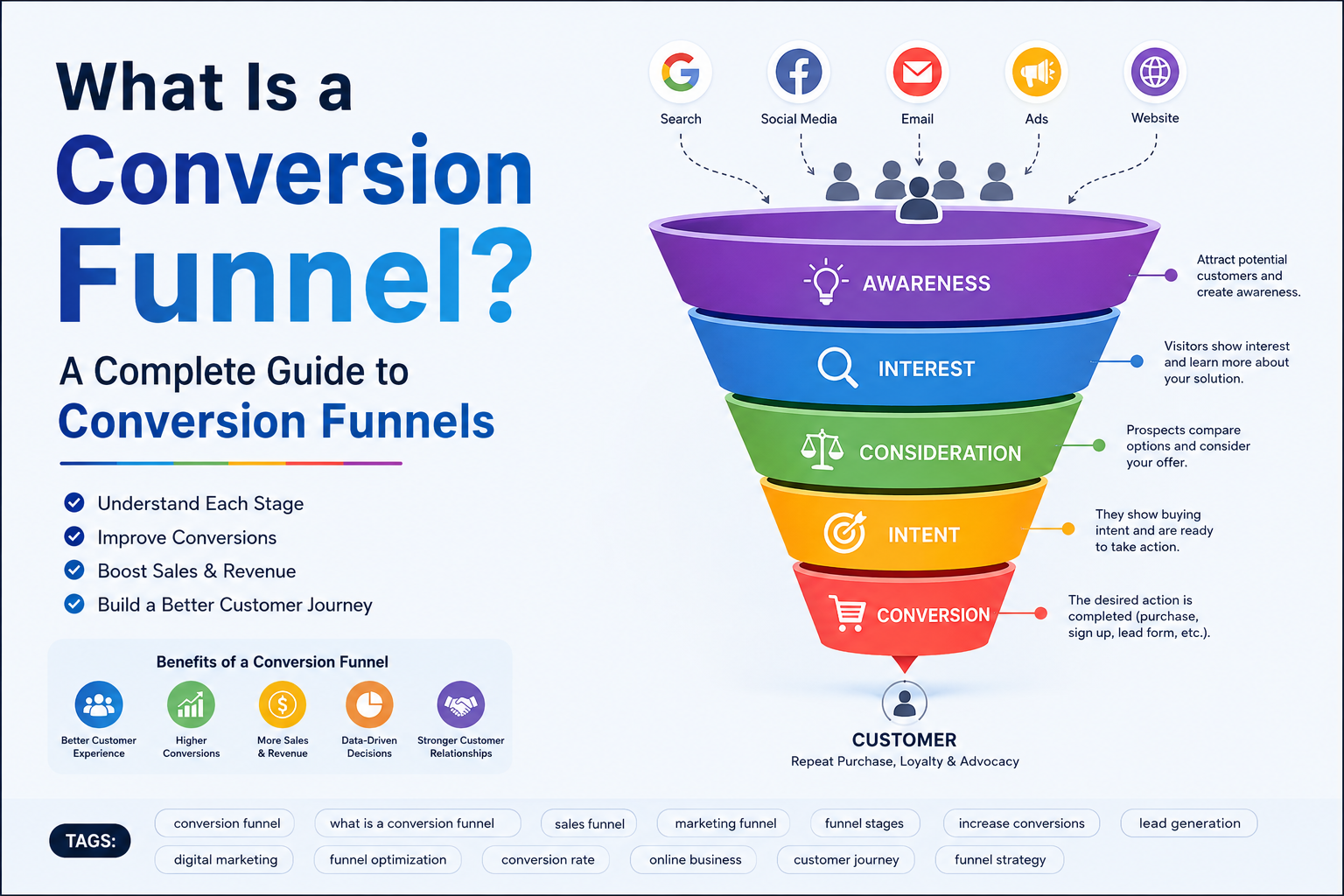
Awareness → Interest → Consideration → Intent → Purchase → Retention
Our content and offers should reflect the customer’s position in this journey.
For example, educational content can work well at the awareness stage, while testimonials, comparisons, demonstrations, and pricing information can be more useful during consideration.
Matching our funnel to the customer’s buying stage can make the overall experience more relevant.
How to Find the Exact Problem With Our Sales Funnel
When a funnel is not converting, we should avoid immediately changing everything.
Instead, we can examine the funnel step by step.
Consider this example:
10,000 Ad Impressions
↓
500 Ad Clicks
↓
400 Landing Page Visitors
↓
80 Leads
↓
20 Product Trials
↓
4 Customers
Every stage provides useful information.
If the advertisement generates very few clicks, we should investigate the audience, advertisement creative, targeting, or message.
If many people click but very few submit the form, we should investigate the landing page, offer, CTA, or form.
If many people become leads but very few purchase, we should examine lead quality, nurturing, pricing, trust, objections, and the sales offer.
This approach allows us to find the biggest bottleneck instead of making random changes.
Sales Funnel Conversion Checklist
Before spending additional money on traffic, we should review the funnel carefully.
Traffic
- Are we targeting the right audience?
- Does the audience have a genuine need?
- Is the traffic relevant to the offer?
- Does our advertisement create the right expectation?
Landing Page
- Is the main benefit immediately clear?
- Does the page match the advertisement?
- Is the headline compelling?
- Is the CTA easy to find?
- Is the page optimized for mobile?
- Are unnecessary distractions removed?
Offer
- Does the product solve a meaningful problem?
- Is the value easy to understand?
- Is the price justified?
- Are objections addressed?
- Is there enough differentiation?
Trust
- Are testimonials available?
- Do we have reviews or case studies?
- Is our business information clear?
- Are policies easy to find?
- Is the purchase process trustworthy?
Checkout
- Is checkout simple?
- Are unnecessary fields removed?
- Are payment methods convenient?
- Are unexpected costs avoided?
- Is the final price clear?
Follow-Up
- Are leads receiving useful emails?
- Are we addressing common objections?
- Are prospects reminded about the offer?
- Are we providing additional value?
Analytics
- Are conversion events tracked correctly?
- Do we know where users leave?
- Are we measuring each funnel stage?
- Are we testing important changes?
How to Fix a Sales Funnel That Is Not Converting
The most effective approach is to optimize the funnel systematically.
First, we should identify the largest conversion drop-off.
Next, we should determine whether the problem comes from:
Traffic → Messaging → Landing Page → Offer → Trust → Checkout → Follow-Up
After identifying the problem, we can make a focused improvement and measure the result.
For example, if the landing page receives hundreds of visitors but almost nobody submits the form, changing the email sequence may have little immediate impact.
The landing page should be investigated first.
Similarly, if we generate hundreds of qualified leads but almost nobody purchases, redesigning the advertisement may not solve the main problem.
The focus should be on the stage that is actually limiting results.
Why More Traffic Is Not Always the Solution
One of the most common mistakes is assuming that a sales funnel needs more visitors.
If the funnel is converting poorly, increasing traffic can simply increase wasted advertising costs.
For example, if a funnel converts 1% of visitors into customers, sending 10,000 additional low-quality visitors may not produce meaningful revenue.
Improving the conversion rate can sometimes be more valuable than simply increasing traffic.
If we increase a funnel from a 1% conversion rate to 2%, the same amount of qualified traffic can potentially generate twice as many conversions.
This is why conversion rate optimization should be considered alongside traffic generation.
When we ask, “Why is my sales funnel not converting?”, the answer is rarely limited to one factor.
The problem could be poor audience targeting, weak messaging, an unclear value proposition, an ineffective CTA, insufficient trust, a complicated checkout process, poor mobile performance, weak follow-up, or an offer that does not provide enough perceived value.
The most effective solution is to examine the complete customer journey.
We should identify where prospects are leaving, understand what is preventing them from moving forward, and optimize the specific stage responsible for the problem.
A successful sales funnel is not simply a funnel that generates a large amount of traffic. It is a system that attracts the right audience, communicates a compelling value proposition, builds trust, removes objections, and makes taking the next step easy.
By continuously measuring, testing, and improving each stage, we can turn an underperforming sales funnel into a more predictable and profitable customer acquisition system.