
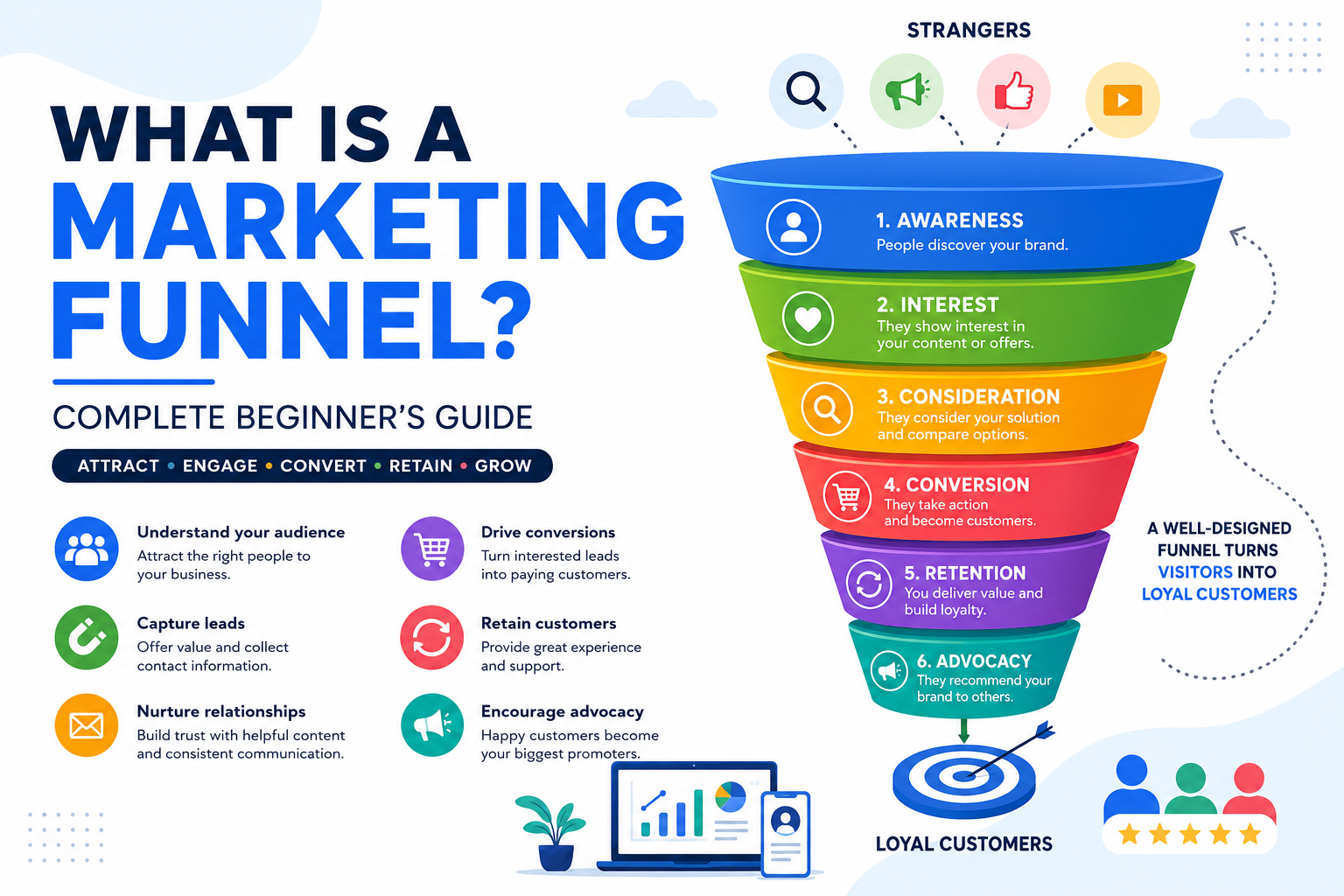

A marketing funnel is a structured process that guides potential customers from their first interaction with a business to a completed purchase and, ideally, toward becoming a repeat customer or loyal advocate. Instead of expecting someone to discover a product and immediately buy it, we use a funnel to provide the right information, offer, and experience at each stage of the customer journey.
The basic idea behind a marketing funnel is simple: people enter at the top, become more interested as they move through the stages, and some eventually become customers. Not everyone who enters the funnel will purchase, which is completely normal. The purpose of the funnel is to attract relevant prospects, build trust, understand their needs, and make it easier for qualified prospects to take action.
A well-designed marketing funnel can help businesses generate leads, increase conversions, automate communication, improve customer relationships, and create a more predictable sales process.
What Is a Marketing Funnel?
A marketing funnel is a model that represents the different stages a person typically moves through before and after making a purchase.
We can think of the funnel as a journey:
Awareness → Interest → Consideration → Conversion → Retention → Advocacy
At the beginning, we have a large audience because many people may see an advertisement, search result, social media post, video, or blog article. As people move through the funnel, some lose interest while others become increasingly engaged.
For example, someone searching for how to create an online business may discover an educational blog post. After reading the article, they may download a free guide. Later, they may receive educational emails about online business tools. Eventually, they might consider purchasing a sales funnel platform.
This entire process can be part of a marketing funnel.
How Does a Marketing Funnel Work?
A marketing funnel works by matching marketing messages and offers with the customer’s level of awareness and intent.
Someone who has never heard of a business usually needs a different message from someone who has already visited a pricing page three times.
We generally divide the funnel into several stages.
1. Awareness: Attracting Potential Customers
The first stage of the marketing funnel is awareness.
At this stage, potential customers may not know the business, product, or solution. Our goal is to reach people who have a problem, need, interest, or desire that relates to what we offer.
Common awareness channels include:
- Search engines
- Blog content
- YouTube videos
- Social media
- Paid advertising
- Display advertising
- Influencer marketing
- Podcasts
- Online communities
- Educational content
For example, a company selling email marketing software might publish an article called “How to Build an Email List From Scratch.”
A person searching for that information may discover the company for the first time.
The primary goal at this stage is not always to make an immediate sale. Instead, we focus on getting the attention of the right audience.
2. Interest: Turning Attention Into Engagement
Once people become aware of a business, the next step is generating interest.
At this point, prospects want to learn more. They may visit the website, read several articles, watch videos, follow a social media account, or subscribe to an email list.
We can encourage engagement by providing useful resources such as:
- Free guides
- Checklists
- Tutorials
- Webinars
- Templates
- Free trials
- Case studies
- Educational videos
- Quizzes
- Email courses
A lead magnet can be especially useful at this stage.
For example, a marketing funnel website could offer a free Marketing Funnel Checklist in exchange for a visitor’s email address.
The visitor receives something useful, while the business receives permission to continue communicating with that potential customer.
3. Consideration: Building Trust and Demonstrating Value
The consideration stage is where prospects start evaluating whether a particular solution is right for them.
They may compare different products, read reviews, investigate pricing, watch demonstrations, or search for alternatives.
For example, someone considering a funnel-building platform might search for:
- Best marketing funnel software
- Marketing funnel builder comparison
- Systeme.io alternatives
- Systeme.io vs ClickFunnels
- Best sales funnel software for beginners
- Marketing funnel software pricing
At this stage, trust becomes extremely important.
We can strengthen trust through:
- Customer testimonials
- Reviews
- Product demonstrations
- Case studies
- Comparison articles
- Frequently asked questions
- Transparent pricing
- Detailed product information
- Free trials or demos
- Educational content
The objective is to remove uncertainty and help prospects understand why the solution may be suitable for their needs.
4. Conversion: Turning Prospects Into Customers
The conversion stage is where the prospect takes the desired action.
That action could be:
- Purchasing a product
- Booking a consultation
- Starting a subscription
- Signing up for a software trial
- Registering for a paid event
- Requesting a quote
- Joining a membership
A conversion funnel should make this process as straightforward as possible.
A confusing checkout process, unclear pricing, weak call-to-action, slow website, or lack of trust can cause prospects to abandon the funnel.
Strong conversion pages generally include a clear value proposition, compelling benefits, social proof, relevant information, and a prominent call-to-action.
For example:
Start Your Free Trial
is usually more direct than a vague button such as:
Click Here
The best call-to-action depends on the audience and offer, but clarity is almost always important.
5. Retention: Keeping Existing Customers
The marketing funnel does not end when someone makes a purchase.
One of the most valuable stages is customer retention.
Acquiring a new customer can require significant time and advertising investment. Once someone becomes a customer, we have an opportunity to provide additional value and develop a long-term relationship.
Retention strategies can include:
- Onboarding emails
- Educational content
- Product tutorials
- Customer support
- Loyalty programs
- Personalized recommendations
- Exclusive offers
- Product updates
- Community access
- Follow-up campaigns
For software businesses, an effective onboarding sequence can help customers understand the product and reach their first success quickly.
A customer who understands how to use a product is generally more likely to continue using it.
6. Advocacy: Turning Customers Into Promoters
The final stage is advocacy.
Satisfied customers can become powerful marketing assets because people often trust recommendations from other customers.
We can encourage advocacy through:
- Referral programs
- Customer reviews
- Testimonials
- Affiliate programs
- Referral incentives
- User-generated content
- Case studies
- Social sharing
For example, a satisfied customer might recommend a software product to another entrepreneur. That recommendation can introduce a new prospect into the awareness stage.
This creates a cycle where existing customers help generate new opportunities.
Marketing Funnel Example
Let’s consider a simple example involving an online course business.
A potential customer sees a Facebook advertisement offering a free guide to building a sales funnel.
The person clicks the advertisement and arrives on a landing page.
The landing page asks for an email address in exchange for the guide.
After submitting the form, the person receives the free resource and enters an email marketing sequence.
Over the next several days, the business sends useful educational emails covering:
- How marketing funnels work
- Common funnel mistakes
- How to generate leads
- How to improve conversions
- How to automate follow-ups
After building trust, the business introduces a paid course.
The prospect reviews the course page, reads testimonials, and decides to purchase.
After purchasing, the customer receives onboarding emails and additional educational content.
This is a complete example of how a marketing funnel can move someone from stranger to customer and eventually to loyal advocate.
What Is the Difference Between a Marketing Funnel and a Sales Funnel?
The terms marketing funnel and sales funnel are often used interchangeably, but there can be a difference.
A marketing funnel generally focuses on attracting and nurturing potential customers.
A sales funnel tends to focus more specifically on moving qualified prospects toward a purchase.
Marketing may generate awareness, traffic, leads, and interest, while sales activities may focus on product demonstrations, consultations, offers, negotiations, and closing.
In many modern businesses, the two systems work together rather than operating independently.
Why Are Marketing Funnels Important?
A marketing funnel gives us a structured way to understand the customer journey.
Without a funnel, businesses may send the same message to everyone regardless of their level of awareness.
A person who has never heard of a product may need education, while an existing customer may be ready for an upgrade.
A funnel helps us create more relevant experiences for different types of prospects.
It can also help us identify where potential customers are being lost.
For example, if thousands of visitors reach a landing page but very few submit a form, the landing page may need improvement.
If many people become leads but very few purchase, we may need to improve the offer, follow-up sequence, pricing, sales process, or trust signals.
How Email Marketing Fits Into a Marketing Funnel
Email marketing is one of the most useful components of many marketing funnels because it allows businesses to communicate with prospects after they leave a website.
Instead of relying on someone to remember a website and return later, we can continue providing useful information through email.
A typical email funnel might look like:
Lead Magnet → Welcome Email → Educational Emails → Problem Awareness → Solution → Offer → Follow-Up
The content should remain relevant to the subscriber.
A good email sequence does not need to aggressively sell in every message. Educational content can help establish credibility and prepare subscribers for an eventual purchase.
How Paid Advertising Works With Marketing Funnels
Paid advertising can bring targeted traffic into the top of a marketing funnel.
Platforms such as search advertising, social advertising, and display advertising can help businesses reach specific audiences.
However, sending paid traffic directly to a poorly designed sales page can result in wasted advertising spend.
A more structured approach can be:
Advertisement → Landing Page → Lead Magnet → Email Sequence → Offer → Sales Page → Purchase
The exact structure depends on the product, price, audience, and buying cycle.
For lower-priced products, the funnel may be very short. For expensive products or services, the funnel may involve multiple interactions before conversion.
Common Marketing Funnel Mistakes
Several mistakes can reduce funnel performance.
Using One Message for Everyone
New visitors, leads, prospects, and customers have different needs. Treating everyone identically can make marketing less relevant.
Making the Funnel Too Complicated
More pages and more steps do not automatically create better results. Every step should have a clear purpose.
Focusing Only on Traffic
Traffic is important, but traffic alone does not create revenue. We need to consider the entire journey from visitor to customer.
Ignoring Follow-Up
Many potential customers are not ready to buy during their first interaction. A useful follow-up process can recover opportunities that would otherwise be lost.
Weak Calls-to-Action
Visitors should understand what action we want them to take next.
Not Measuring Performance
Without tracking funnel metrics, it becomes difficult to understand what is working and what needs improvement.
Marketing Funnel Metrics to Track
Important metrics can include:
- Website traffic
- Landing page conversion rate
- Lead conversion rate
- Email open rate
- Email click-through rate
- Sales conversion rate
- Customer acquisition cost
- Average order value
- Customer lifetime value
- Return on advertising spend
- Cart abandonment rate
Tracking these numbers allows us to identify weaknesses and optimize individual stages.
For example, increasing a landing page conversion rate from 5% to 8% can significantly increase the number of leads generated from the same amount of traffic.
How to Build a Simple Marketing Funnel
We can start with a straightforward funnel instead of trying to build a complicated system immediately.
Step 1: Define the target audience.
Identify who we want to attract and understand their primary problems, goals, questions, and objections.
Step 2: Create useful content or an advertisement.
Use content or paid traffic to attract relevant visitors.
Step 3: Create a landing page.
Give visitors a clear reason to take the next step.
Step 4: Capture leads.
Offer a useful resource or compelling reason for prospects to provide their contact information.
Step 5: Nurture leads.
Use email marketing and educational content to build trust.
Step 6: Present the offer.
Explain the product’s benefits, value, features, proof, and pricing clearly.
Step 7: Optimize conversions.
Monitor results and improve the weakest part of the funnel.
Step 8: Retain customers.
Provide excellent onboarding, support, and continued value.
How Marketing Funnels Work
A marketing funnel works by guiding potential customers through a series of stages rather than expecting an immediate purchase.
We attract attention through content, advertising, search, social media, and other channels. We then turn attention into engagement, capture qualified leads, build trust, present relevant offers, and support customers after conversion.
The strongest marketing funnels are not necessarily the most complicated. They are the ones that understand the customer’s journey and provide the right information at the right stage.
Whether we are promoting software, an online course, professional services, ecommerce products, or affiliate offers, the fundamental principle remains the same: attract the right people, provide value, build trust, make the next step clear, and continue improving the customer experience.
When each stage works together, a marketing funnel can become a repeatable system for generating leads, increasing sales, and building long-term customer relationships.