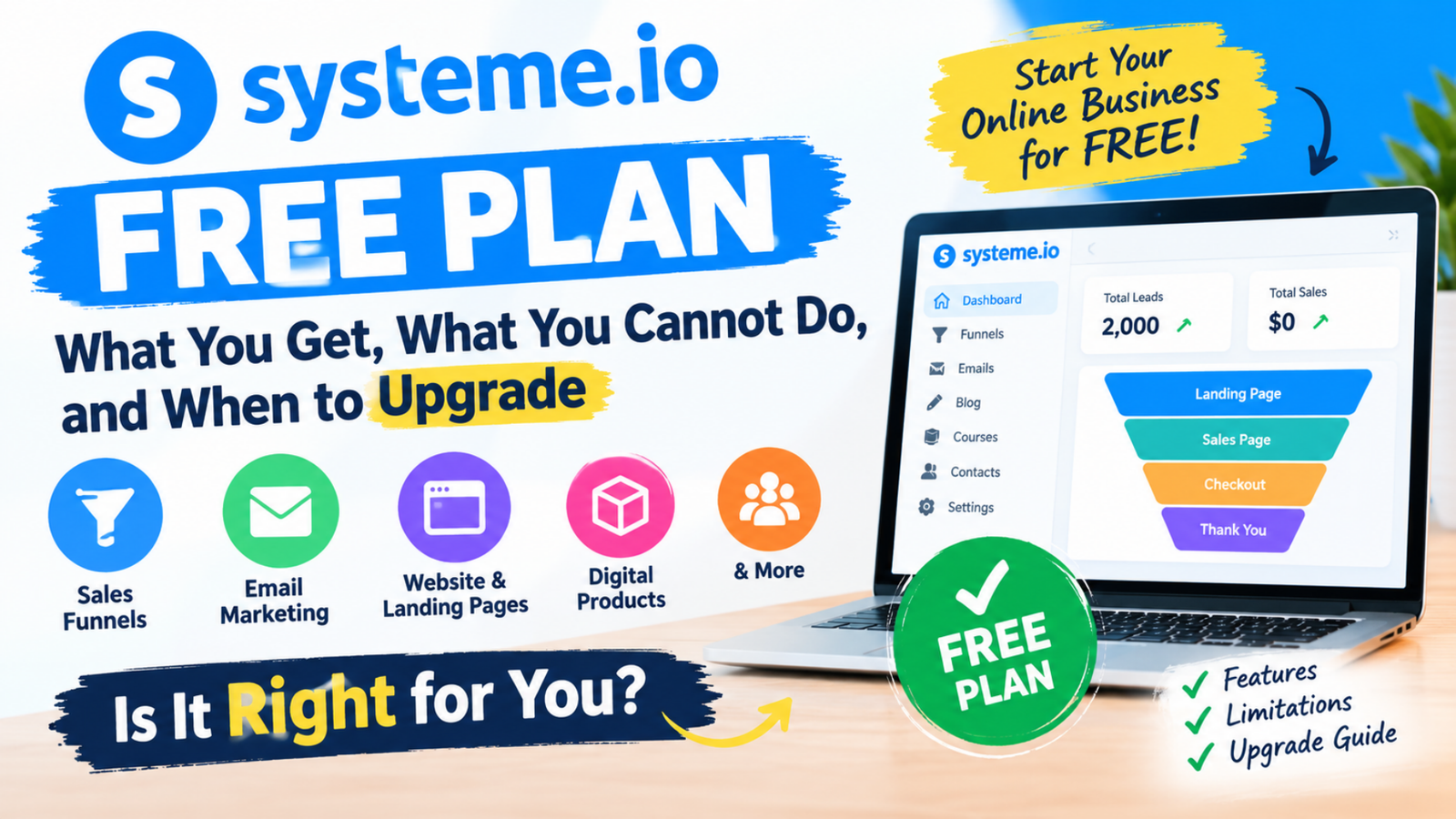

Starting an online business does not have to require a large investment. Whether we want to sell digital products, launch an email marketing campaign, create a sales funnel, or build an online course, choosing the right platform can make a significant difference to our budget and long-term growth.
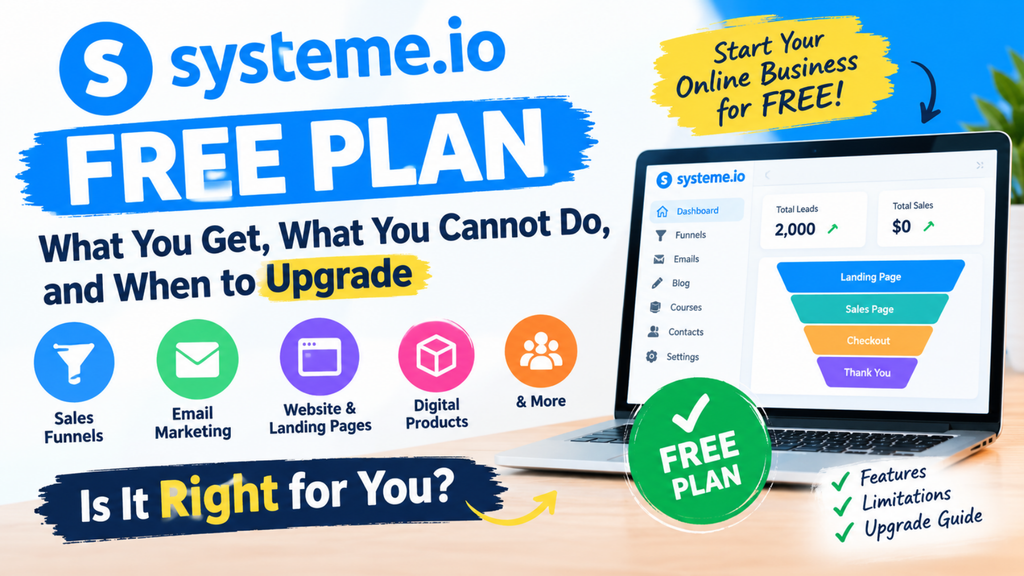
Systeme.io’s free plan is an attractive option for entrepreneurs who want to start an online business without paying a monthly subscription. Instead of purchasing separate tools for email marketing, website creation, sales funnels, and digital product delivery, we can manage several essential business activities from one platform.
However, a free plan also has limitations. As our business grows, we may need additional sales funnels, more email contacts, advanced automation, or other features that are not available within the free tier.
In this guide, we will explore what the Systeme.io free plan includes, what we cannot do with it, how it can support a digital product business, and when upgrading to a paid plan makes financial sense.
What Is Systeme.io?
Systeme.io is an all-in-one online business platform that combines several marketing and sales tools in one place. It is designed for entrepreneurs, content creators, coaches, affiliate marketers, and digital product sellers who want to build an online business without managing multiple subscriptions.
Traditionally, starting an online business might require separate tools for creating landing pages, collecting email addresses, sending newsletters, building sales funnels, and delivering digital products. These services can quickly increase monthly expenses, especially when a business is not generating consistent revenue.
Systeme.io aims to simplify this process by bringing these functions together.
Depending on the features available in the selected plan, users can create sales funnels, build websites and blogs, manage email contacts, set up marketing automation, sell digital products, and develop online courses.
For beginners, the biggest advantage is the ability to start building an online business without committing to a monthly software expense. This is particularly useful when testing a business idea or trying to generate the first few sales.
What Do We Get With the Systeme.io Free Plan?
The free plan is intended to provide the basic tools needed to establish an online business. Its exact limits and feature availability should be checked before making business decisions because software plans can change over time.
Here are the main capabilities to consider when evaluating the free plan.
1. Sales Funnel Creation
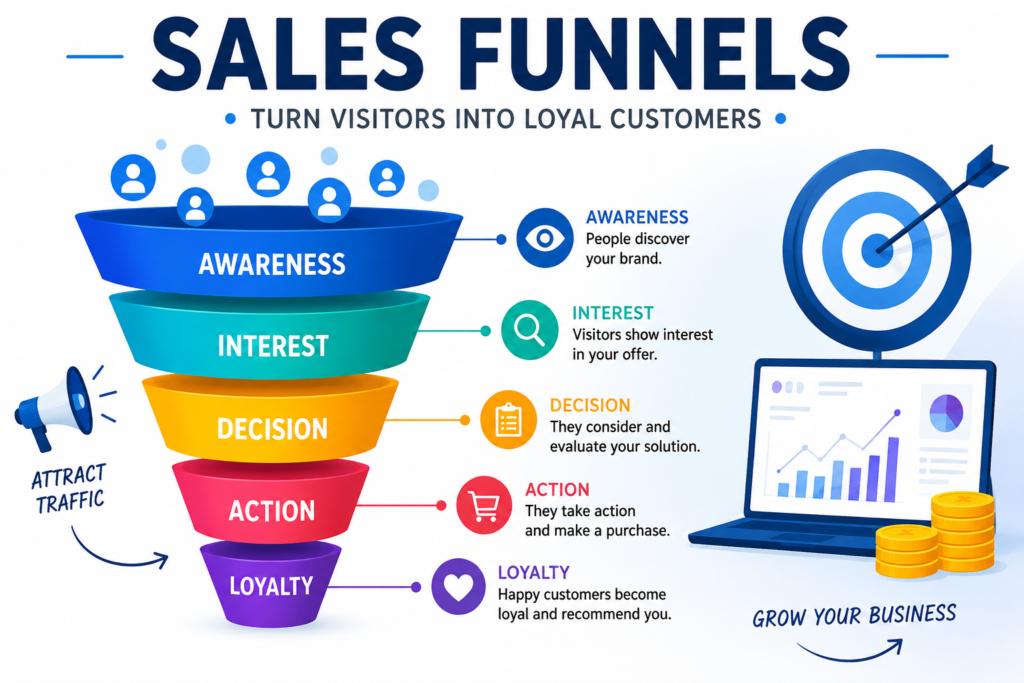
A sales funnel is a series of pages that guides potential customers from discovering a product to completing a purchase.
For example, if we sell an ebook, we might create a landing page explaining the benefits of the ebook, a sales page displaying the price, and a checkout page where customers can complete their orders.
With Systeme.io, we can use sales funnels to organize this process in one place.
A simple ebook sales funnel could include:
- Landing page: Introduces the ebook and attracts potential buyers.
- Sales page: Explains the product, its benefits, and its price.
- Checkout page: Allows customers to purchase the product.
- Thank-you page: Confirms the purchase and provides the next steps.
Having these pages connected makes it easier to create a straightforward buying experience without building a complicated website.
For beginners, this is one of the most useful aspects of Systeme.io’s free offering. We can focus on presenting our product clearly and attracting customers instead of spending money on multiple website-building tools.
2. Email Marketing Tools
Email marketing helps us communicate with potential customers and existing buyers. It can be used to share product information, send updates, deliver promotional offers, and encourage repeat purchases.
Systeme.io combines email marketing capabilities with its other business tools, making it possible to manage contacts and campaigns within the same platform.
For example, when someone downloads a free ebook or subscribes to our newsletter, we can collect their email address through a landing page. We can then communicate with those subscribers, subject to the platform’s feature limits and applicable email marketing requirements.
Email marketing can be particularly valuable for digital product sellers because it allows us to build an audience instead of relying entirely on paid advertising.
Suppose we advertise an ebook but a visitor does not purchase it immediately. If that visitor voluntarily subscribes to our email list, we may be able to share useful content and introduce the product again through follow-up campaigns.
The key benefit is that we can build relationships with potential customers without paying for a separate email marketing platform at the beginning.
3. Website and Landing Page Building
A website provides a central location where visitors can learn about our business, explore our products, and find information about our offers.
Landing pages serve a more specific purpose: encouraging visitors to take one action, such as purchasing an ebook, subscribing to a newsletter, or registering for a webinar.
Systeme.io provides website and page-building capabilities, subject to the limits of the chosen plan.
For a beginner, a full website may not even be necessary. A well-designed landing page with a clear headline, useful product description, relevant images, customer-focused benefits, and a prominent purchase button can be enough to start selling.
For example, an ebook seller could create a page that explains:
- What the ebook covers.
- Who the ebook is intended for.
- What readers can learn from it.
- Why the product is useful.
- How much it costs.
- How buyers receive the digital file after purchasing.
This approach allows us to establish an online presence without investing heavily in website development.
4. Digital Product Selling
One of the most appealing uses of Systeme.io is selling digital products online.
Digital products can include ebooks, downloadable guides, templates, educational resources, online courses, and other digital materials.
Unlike physical products, digital products generally do not require inventory storage or shipping. Once the product is prepared, we can sell copies to multiple customers through an online sales process.
For example, if we create an ebook and price it at ₹499, we can promote the product through social media, email marketing, organic content, or paid advertising.
The sales funnel can introduce the ebook, explain its value, and guide interested visitors toward checkout.
Before launching, we should verify the current plan’s supported payment methods, product-delivery options, transaction requirements, and any applicable third-party processing fees.
The free plan can be a practical starting point for testing whether customers are willing to pay for our digital products before we commit to additional monthly software costs.
5. Affiliate Marketing Opportunities
Affiliate marketing is another business model that can benefit from sales funnels and email marketing.
In affiliate marketing, we promote products or services offered by other businesses and may earn a commission when someone completes a qualifying purchase through our affiliate link.
Systeme.io can support certain affiliate marketing workflows through its page-building, contact-management, and marketing tools. However, we should distinguish between promoting other companies’ products and joining Systeme.io’s own affiliate program, which has its own terms and eligibility requirements.
For beginners, a basic affiliate funnel might contain an educational landing page, useful product information, and a clearly disclosed affiliate link.
The objective should be to provide genuine value rather than simply sending visitors to promotional offers.
By combining content marketing with email list building, we can gradually develop an audience that may be interested in relevant products and recommendations.
6. An Affordable Way to Test a Business Idea
Perhaps the greatest advantage of a free plan is the ability to test an idea without immediately increasing our monthly expenses.
When starting an online business, we may not know whether our product will sell, which audience will respond, or how much advertising will be required to generate a profitable sale.
Paying for several software subscriptions before answering these questions can put unnecessary pressure on a limited budget.
With a free platform, we can start with a simple product, create a sales page, establish a basic marketing process, and measure customer interest.
Once we have evidence that our offer attracts buyers, we can decide whether additional features are worth paying for.
This makes Systeme.io’s free plan especially useful for beginners, small digital product businesses, and entrepreneurs who want to validate an offer before investing more money.
Systeme.io Free Plan: Complete Features and Limitations
Before building our business around the free plan, we should understand its main usage limits.
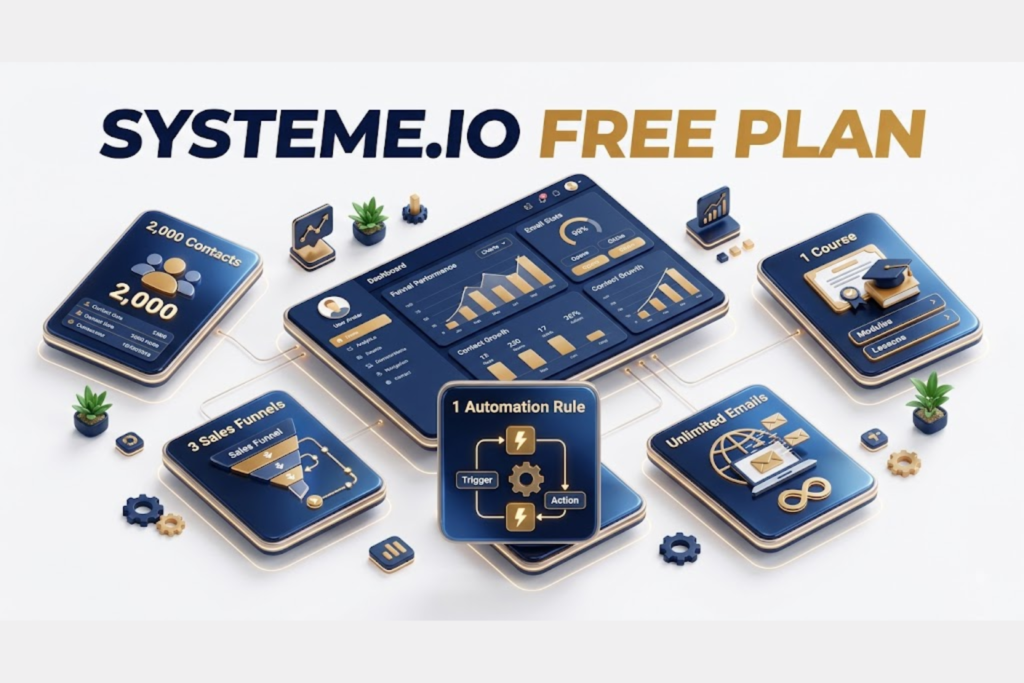
The free plan has been listed with the following features and limits. These details should be verified against the current plan before making a final decision.
| Feature | Free Plan Limit |
|---|---|
| Monthly subscription | $0 |
| Contacts | Up to 2,000 |
| Sales funnels | 3 |
| Sales funnel steps | 15 |
| Email sending | Unlimited |
| Email campaigns | 1 |
| Automation rules | 1 |
| Workflows | 1 |
| Custom domains | 1 |
| Blogs | 1 |
| Courses | 1 |
| One-click upsells | 1 |
| File storage | Unlimited |
| Transaction fees charged by Systeme.io | 0% |
These limits make the free plan useful for a small online business. However, the number of funnels, email campaigns, and automation rules can become important as we develop multiple products or marketing strategies.
For example, we might initially need only one funnel to sell an ebook. Later, we may want separate funnels for a second ebook, a free lead magnet, an affiliate offer, and a bundle of digital products. At that stage, our available funnel capacity may become restrictive.
The same applies to email marketing. Unlimited email sending does not mean unlimited email campaigns, unlimited contacts, or unlimited automation features. We should distinguish between how many emails we can send and how many separate marketing systems we can create.
What Cannot We Do With the Systeme.io Free Plan?
Although Systeme.io offers several useful tools at no monthly cost, the free plan is not designed to provide unlimited business capacity.
1. We Cannot Build Unlimited Sales Funnels
The free plan allows up to three sales funnels. This is enough for many beginners, but it can become restrictive when we expand our product catalog.
Consider a digital product business selling several ebooks. We might want one funnel for each ebook, another for a bundle, and another for a free ebook used to collect email subscribers.
With only three funnels available, we need to prioritize which offers deserve their own dedicated sales process.
We can start with our best-selling or most promising product and expand later. However, if our business requires more funnels, upgrading may become necessary.
2. We Have Limited Marketing Automation
Automation helps us send messages or perform actions automatically when customers take specific steps.
For example, when a customer purchases an ebook, an automated process could send a confirmation email, deliver purchase instructions, and introduce a related product.
The free plan limits the number of automation rules and workflows we can create. This means we need to keep our initial marketing process simple and check which automation actions are supported by our account.
For a beginner, a basic welcome or follow-up process may be sufficient. As we introduce more products, customer segments, and promotional campaigns, additional automation capacity can become valuable.
3. We Cannot Exceed the Free Plan’s Contact Limit
The free plan supports up to 2,000 contacts.
When we start, this limit may be more than sufficient. However, successful lead-generation campaigns can gradually increase the size of our email list.
If our contact list approaches the limit, we may need to remove contacts we no longer need, review our list management practices, or upgrade to a higher plan.
A larger contact limit is particularly useful for businesses that rely on email marketing to promote new products and encourage repeat purchases.
4. We Have Limited Email Campaign Options
Systeme.io allows unlimited email sending on the free plan, but the number of email campaigns we can create is limited.
This distinction matters because email sending and campaign creation are different capabilities.
For instance, a business might want separate campaigns for new subscribers, previous customers, abandoned purchases, and people interested in different products.
With limited campaign capacity, we must organize our marketing carefully and determine which communication processes are most important.
We should also remember that sending unlimited emails does not guarantee inbox placement, high engagement, or sales. Email quality, subscriber consent, deliverability, and the relevance of our messages remain important.
5. Advanced Growth Features May Require an Upgrade
As our business develops, we may want to test multiple versions of a sales page, run automated webinars, create additional courses, or build more complex marketing systems.
Some capabilities have plan-specific limits, while certain features, such as evergreen webinars, are available only on higher-tier plans.
The appropriate plan therefore depends on our actual requirements, not simply on the number of features listed in a pricing comparison.
We should avoid upgrading just because a paid plan looks more professional. If the free plan already supports our current sales process, keeping our expenses low may be the smarter decision.
Is Systeme.io Free Plan Good for Selling Ebooks?
Yes. Systeme.io’s free plan can be a suitable starting point for selling ebooks and other digital products, provided that the available features meet our requirements.
For a beginner, the main objective should be to validate the product and establish a reliable sales process before adding unnecessary expenses.
A simple ebook business can follow this structure:
- Create an ebook that solves a specific problem for a clearly defined audience.
- Build a landing page explaining the product and its benefits.
- Set up the checkout process using a supported payment provider.
- Configure the product-delivery process.
- Promote the ebook through organic content or paid advertisements.
- Track sales, advertising expenses, and actual payments received.
This approach allows us to focus on the most important business questions: Are people interested in the product? Are they willing to pay for it? Can we acquire customers at a sustainable cost?
We should confirm that our chosen payment gateway and delivery setup work correctly before sending paid traffic to the sales page.
Example: Selling an Ebook for ₹499
Suppose we sell an ebook for ₹499 and want to test whether paid advertising can generate profitable sales.
| Business Activity | Example Amount |
|---|---|
| Advertising investment | ₹2,000 |
| Number of sales | 10 |
| Gross sales revenue | ₹4,990 |
| Advertising cost | ₹2,000 |
| Amount remaining before other costs | ₹2,990 |
In this example, we generate ₹4,990 in sales after spending ₹2,000 on advertising.
However, the remaining ₹2,990 is not necessarily our final profit. Payment processing fees, refunds, taxes, software expenses, and other business costs may reduce the amount.
We must also distinguish between gross sales and money actually received in our bank account. A sale may be recorded before the payment provider transfers the funds.
This is why tracking three essential figures is useful:
- Investment: How much money we spend on advertising.
- Sales: How much revenue our ebook generates.
- Bank receipts: How much money we actually receive.
Keeping these figures separate helps us understand whether our business is generating positive cash flow.
When Should We Upgrade From the Systeme.io Free Plan?
We should consider upgrading when the free plan begins restricting activities that can reasonably help our business grow.
Upgrade When We Need More Sales Funnels
If we already have three active funnels and need another one for a profitable product, a paid plan may be worth considering.
We should compare the cost of upgrading with the potential benefits of adding the new funnel.
Upgrade When Our Contact List Approaches 2,000
A growing email list can become a valuable business asset. If we regularly attract new subscribers and need more contact capacity, upgrading may be more practical than continually reducing our list.
Upgrade When We Need More Automation
If manual tasks are taking too much time or we need additional automation rules and workflows, a paid plan may improve efficiency.
We should first identify the exact feature we need and verify which plan includes it.
Upgrade When the Additional Cost Is Justified
The strongest reason to upgrade is not simply that our business is growing. It is that the paid features provide enough practical value to justify their cost.
For example, if an upgrade costs $17 per month, we should evaluate whether the additional functionality saves time, supports additional sales, or removes a restriction that is holding back our business.
We should also consider currency conversion, applicable taxes, and the payment terms displayed at checkout.
The goal is to maintain a sensible balance between business growth and operating expenses.
Systeme.io Free Plan vs. Paid Plans
Systeme.io offers multiple plans for businesses with different requirements. The main plans include Free, Startup, Webinar, and Unlimited, with paid tiers generally providing higher limits and additional capabilities.
| Plan | Best Suited For |
|---|---|
| Free | Beginners testing an idea or selling their first digital product |
| Startup | Small businesses needing more funnels, contacts, and automation |
| Webinar | Businesses that need greater capacity and webinar features |
| Unlimited | Businesses requiring extensive capacity across funnels, contacts, and other features |
For most beginners, the free plan is a sensible place to start. We can establish our basic sales process, learn how the platform works, and determine whether our offer attracts paying customers.
The Startup plan may be the next logical step when we need more capacity. The Webinar and Unlimited plans are generally more relevant when our marketing requirements become more complex.
Because pricing and feature limits can change, we should verify the current terms before choosing a paid subscription.
How to Get the Most Out of the Systeme.io Free Plan
We can make the free plan more effective by keeping our business model simple and focusing on activities that directly contribute to sales.
Start with one main product. Instead of launching multiple products simultaneously, focus on developing and marketing one strong offer.
Build one effective sales funnel. Create a clear landing page, a straightforward checkout process, and a reliable delivery experience. Avoid unnecessary pages that complicate the buying journey.
Use email marketing strategically. Build an email list with permission and send relevant content that helps subscribers understand the value of our products.
Track advertising performance. Record advertising investment, sales revenue, and bank receipts separately. This makes it easier to identify whether our marketing is producing a positive financial result.
Avoid unnecessary subscriptions. Before paying for another tool, check whether Systeme.io already provides the capability we need.
Review our results before upgrading. Upgrade when we encounter a specific limitation or when additional functionality offers a reasonable business benefit.
This disciplined approach helps us preserve cash while learning which products, audiences, and marketing methods work best.
Frequently Asked Questions About the Systeme.io Free Plan
Is Systeme.io Really Free?
Yes. Systeme.io offers a free plan with no monthly subscription fee. It includes core business tools subject to usage limits. Other expenses, such as domain registration and third-party payment processing fees, may still apply.
Can We Sell Digital Products Using Systeme.io for Free?
Yes. We can use the platform to create sales funnels and sell supported digital products, subject to the free plan’s limits and payment setup requirements. Third-party payment processing fees may still apply.
Does the Systeme.io Free Plan Include Email Marketing?
Yes. The free plan includes email marketing capabilities and unlimited email sending, although the number of contacts, campaigns, and automation tools is limited.
How Many Sales Funnels Can We Create With the Free Plan?
The free plan has been listed with a maximum of three sales funnels and 15 funnel steps. We should confirm the latest limits in our account before planning a larger funnel structure.
Can We Use a Custom Domain on the Free Plan?
The free plan has been listed as including one custom domain, subject to the platform’s setup requirements. We may need to purchase the domain separately from a domain registrar.
Is Systeme.io Suitable for Beginners?
Yes. Its combination of sales funnels, email marketing, website building, and digital product tools makes it useful for beginners who want to avoid managing several separate platforms.
When Is the Best Time to Upgrade?
The best time to upgrade is when we need more capacity or a specific paid feature that supports our business goals. Until then, using the free plan can help us keep expenses under control.
Final Verdict: Is the Systeme.io Free Plan Worth It?
Systeme.io’s free plan is a practical starting point for entrepreneurs who want to build an online business without paying a monthly platform subscription.
It provides useful tools for creating sales funnels, collecting contacts, sending emails, building a website, and selling digital products. For someone launching an ebook business, these capabilities can be sufficient to test a product and begin generating sales.
The main limitations are its contact capacity, number of sales funnels, email campaigns, automation rules, and other usage restrictions. These limits matter more as the business expands, but they do not necessarily prevent a beginner from getting started.
Our recommendation is straightforward: start with the free plan, focus on selling one product, measure the results, and upgrade only when a genuine business need justifies the additional expense.
By keeping software costs low and monitoring advertising investment, sales revenue, and bank receipts, we can make better decisions about how to grow our digital product business sustainably.