
A marketing funnel is a step-by-step process that helps businesses turn people who are unfamiliar with a brand into interested prospects and, eventually, paying customers. It provides a structured way to understand how people discover a business, evaluate its products or services, make purchasing decisions, and potentially become repeat customers.
Whether we run an online store, service business, SaaS company, coaching business, affiliate website, or personal brand, understanding the marketing funnel can help us create a more organized and effective customer acquisition strategy.
Instead of trying to sell something to every visitor immediately, we guide potential customers through different stages based on their level of awareness and interest.
What Is a Marketing Funnel?
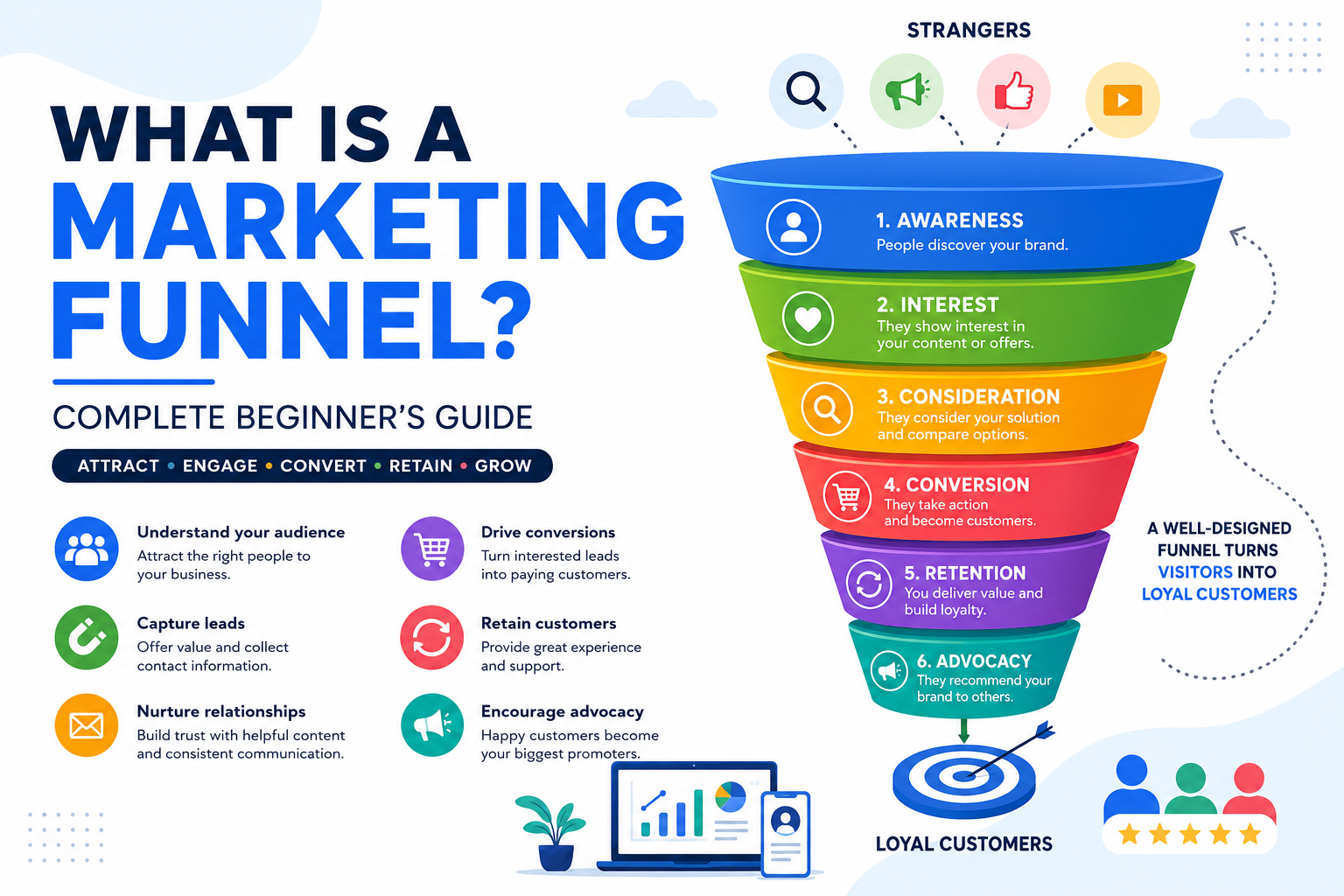
A marketing funnel is a model that represents the customer journey from the first interaction with a business to a purchase and beyond.
The funnel is usually divided into several stages:
- Awareness
- Interest
- Consideration
- Conversion
- Retention
- Advocacy
The exact terminology can vary between businesses, but the fundamental idea remains the same: not every person who discovers a business is ready to buy immediately.
For example, imagine that we sell an online marketing course.
A potential customer might first discover our website through Google. They read a blog post about digital marketing and become aware of our brand. They then download a free marketing checklist, subscribe to our email newsletter, read several educational emails, compare our course with alternatives, and eventually purchase the course.
That entire journey can be viewed as a marketing funnel.
How Does a Marketing Funnel Work?
A marketing funnel works by moving potential customers through increasingly deeper levels of engagement.
At the top of the funnel, we have a large audience that may know little or nothing about our business. As people become more interested, the audience becomes smaller. Eventually, a percentage of those prospects become customers.
A simple funnel can look like this:
Visitors → Leads → Prospects → Customers → Repeat Customers → Brand Advocates
The purpose is not simply to push everyone toward a sale. Instead, we provide the right information, offer, and experience at each stage.
For example, someone searching for “what is email marketing” may not be ready to purchase an email marketing platform. Showing that person a hard-sell sales page may not work.
However, an educational article, free guide, checklist, or email course can build trust and move that visitor toward the next stage.
Marketing Funnel Stages Explained
1. Awareness Stage
The awareness stage is the top of the marketing funnel.
At this stage, people are discovering a problem, need, brand, product category, or solution. They may not know our business yet.
Common sources of awareness include:
- Google search
- Social media
- YouTube
- Blog content
- Paid advertising
- Influencer marketing
- Podcasts
- Online communities
- Referrals
- Guest posts
- Display advertising
For example, someone searching Google for “how to get more leads for my business” may discover an article on our website.
The objective at this stage is to attract the right audience and provide useful information.
Content is particularly important because people at the awareness stage often want answers rather than an immediate sales pitch.
Useful awareness-stage content includes:
- Beginner guides
- Educational blog posts
- Videos
- Social media posts
- Infographics
- Industry reports
- Free resources
- How-to tutorials
2. Interest Stage
Once people become aware of our business or solution, they may move into the interest stage.
Here, visitors begin actively exploring the topic and learning more about possible solutions.
They may:
- Read multiple blog posts
- Follow our social media account
- Watch product videos
- Subscribe to an email list
- Download a free resource
- Visit product pages
- Join a webinar
- Compare solutions
At this point, we need to provide enough value to encourage the visitor to continue engaging with our business.
A lead magnet can be particularly useful here.
Examples include:
- Free ebook
- Checklist
- Template
- Free course
- Webinar
- Free consultation
- Calculator
- Trial
- Case study
The goal is to convert an anonymous website visitor into an identifiable lead, usually by collecting an email address or another appropriate contact method with permission.
3. Consideration Stage
At the consideration stage, prospects understand their problem and are actively evaluating potential solutions.
They may compare:
- Features
- Pricing
- Reviews
- Benefits
- Alternatives
- Customer support
- Ease of use
- Results
- Integrations
- Guarantees
- Case studies
This is where comparison and decision-making content becomes valuable.
For example, someone searching for “Systeme.io vs GetResponse” is likely further along the funnel than someone searching for “what is email marketing?”
The first search indicates that the person may already understand the category and is evaluating specific solutions.
Content that works well during consideration includes:
- Product comparisons
- Detailed reviews
- Case studies
- Testimonials
- Demonstrations
- Product tours
- FAQ pages
- Pricing explanations
- Feature comparisons
- Expert guides
4. Conversion Stage
The conversion stage is where a prospect takes the desired action.
In many businesses, this action is a purchase. However, conversion does not always mean a sale.
Depending on our business model, a conversion could be:
- Purchasing a product
- Starting a free trial
- Booking a consultation
- Requesting a quote
- Signing up for software
- Registering for an event
- Submitting a contact form
- Becoming an affiliate
- Downloading a paid resource
A strong conversion stage should remove unnecessary friction.
We can improve conversions by making our offer clear and providing relevant information about:
- What the customer receives
- Who the product is for
- The main benefits
- Pricing
- Features
- Customer support
- Refund policies where applicable
- Frequently asked questions
- Social proof
- The next step
A clear call to action (CTA) is also essential.
Examples include:
Start Free Trial
Get Started
Book a Demo
Download the Guide
Create Your Account
5. Retention Stage
A marketing funnel should not stop when someone becomes a customer.
The retention stage focuses on keeping customers engaged and encouraging them to continue using our product or services.
Customer retention can include:
- Onboarding emails
- Product tutorials
- Customer support
- Educational content
- Product updates
- Loyalty programs
- Exclusive offers
- Personalized recommendations
- Customer communities
Retention is important because acquiring a new customer can require significant time and marketing investment.
A positive customer experience can also create opportunities for repeat purchases, upgrades, and referrals.
6. Advocacy Stage
The final stage is advocacy.
Satisfied customers may recommend our business to friends, colleagues, audiences, or online communities.
This can create a powerful feedback loop:
Customer → Happy Customer → Reviewer → Referral → New Prospect
Advocacy can come through:
- Reviews
- Testimonials
- Referrals
- Social media mentions
- Case studies
- Word-of-mouth recommendations
- User-generated content
The best marketing funnels therefore create value beyond the initial transaction.
What Is a Sales Funnel vs Marketing Funnel?
The terms marketing funnel and sales funnel are closely related, but they are not always identical.
A marketing funnel generally focuses on attracting and nurturing potential customers.
A sales funnel tends to focus more specifically on the process of converting qualified prospects into customers.
For example:
Marketing funnel:
Awareness → Education → Lead generation → Nurturing
Sales funnel:
Qualified lead → Sales conversation → Proposal → Purchase
In smaller businesses, the two concepts often overlap significantly.
Marketing Funnel Example for an Online Business
Suppose we operate an online business selling marketing software.
Our funnel could look like this:
Step 1: Google Search
A user searches for “best sales funnel software.”
Step 2: Blog Article
They discover our comparison article.
Step 3: Lead Magnet
We offer a free sales funnel checklist.
Step 4: Email Subscription
The visitor enters their email address to receive the checklist.
Step 5: Email Nurturing
We send educational emails about sales funnels, lead generation, landing pages, and automation.
Step 6: Product Comparison
The prospect reads our detailed software comparison.
Step 7: Offer
We introduce the recommended solution and explain its benefits.
Step 8: Conversion
The prospect signs up or purchases.
Step 9: Follow-Up
We provide onboarding content and relevant recommendations.
This is a basic example of how a digital marketing funnel can turn organic traffic into leads and customers.
What Is a Lead Magnet in a Marketing Funnel?
A lead magnet is a valuable free resource offered in exchange for contact information, typically an email address.
Lead magnets are commonly used to increase lead generation.
Examples include:
- Free checklist
- Ebook
- Template
- Spreadsheet
- Mini-course
- Webinar
- Free consultation
- Report
- Toolkit
- Free trial
The most effective lead magnets solve a specific problem for a specific audience.
Instead of offering a generic “Free Marketing Ebook,” we might offer something more specific such as “25 Marketing Funnel Ideas for Small Businesses.”
Specificity can make an offer more relevant to the visitor.
What Is a Funnel Landing Page?
A funnel landing page is a focused page designed to encourage visitors to complete a specific action.
Unlike a general homepage, a landing page usually has a single primary objective.
For example, the objective might be to:
- Collect email addresses
- Sell a product
- Register users for a webinar
- Promote a free trial
- Schedule a consultation
- Download a resource
An effective landing page typically contains:
- Clear headline
- Supporting description
- Benefits
- Relevant visuals
- Social proof
- Strong CTA
- FAQ section
- Trust elements
The page should make it obvious what visitors should do next.
Marketing Funnel vs Customer Journey
A marketing funnel and customer journey describe related concepts but approach the customer experience differently.
A funnel traditionally represents movement through stages, often from a large audience toward a smaller number of customers.
A customer journey considers the broader experience a person has with a brand, including interactions before, during, and after purchasing.
The customer journey can therefore continue long after the funnel’s initial conversion.
Why Is a Marketing Funnel Important?
A well-designed marketing funnel helps us understand where potential customers are in the buying process.
It can help us:
- Generate more qualified leads
- Improve conversion rates
- Create targeted content
- Understand customer behavior
- Reduce wasted advertising spend
- Improve follow-up
- Increase customer retention
- Identify weaknesses in the buying process
- Build repeatable marketing systems
Without a structured funnel, businesses may attract traffic without having a clear process for turning that traffic into revenue.
How to Build a Marketing Funnel
Building a marketing funnel does not necessarily require a complicated system.
We can start with these steps.
Step 1: Define the Target Audience
First, we identify exactly who we want to attract.
We should understand their:
- Problems
- Goals
- Questions
- Buying motivations
- Objections
- Budget
- Preferred channels
Step 2: Define the Main Problem
Next, we identify the specific problem our product or service solves.
The clearer the problem, the easier it becomes to create relevant content and offers.
Step 3: Create Awareness Content
We can publish useful content designed around the questions our audience searches for.
Examples include:
- Blog articles
- Videos
- Guides
- Tutorials
- Social media content
Step 4: Create a Lead Capture Opportunity
We can offer a useful resource and provide visitors with an opportunity to subscribe.
This transforms some visitors into leads that we can nurture with permission.
Step 5: Nurture Leads
Email marketing can help us educate prospects and answer common questions.
Rather than sending only promotional messages, we should provide useful information that helps prospects make better decisions.
Step 6: Present the Offer
Once prospects have enough information, we can introduce the relevant product or service.
The offer should clearly communicate the problem, solution, benefits, pricing, and next step.
Step 7: Follow Up
Many potential customers do not purchase during their first interaction.
Appropriate follow-up can help address unanswered questions and keep the business top of mind.
Common Marketing Funnel Mistakes
Trying to Sell Too Early
A visitor who has just discovered our brand may not be ready to purchase.
We should match the message to the visitor’s level of awareness.
Creating Too Much Friction
Long forms, confusing navigation, unclear pricing, and complicated checkout processes can reduce conversions.
Ignoring Mobile Users
A significant portion of online traffic comes from mobile devices. Landing pages, forms, emails, and checkout processes should provide a good mobile experience.
Not Tracking Funnel Performance
Without measurement, it becomes difficult to determine where prospects are dropping out.
Important metrics can include:
- Website traffic
- Lead conversion rate
- Cost per lead
- Email open rate
- Click-through rate
- Sales conversion rate
- Customer acquisition cost
- Average order value
- Customer lifetime value
- Retention rate
Using the Same Message for Everyone
Someone discovering our brand for the first time should not necessarily receive the same message as an existing customer.
Segmentation allows us to make our communication more relevant.
Marketing Funnel Tools
Modern businesses can use different types of software to build and manage funnels.
Common categories include:
- Landing page builders
- Email marketing platforms
- CRM systems
- Marketing automation tools
- Analytics platforms
- Form builders
- Webinar platforms
- Payment systems
- Customer support tools
An all-in-one platform can combine several of these functions into one system, which can simplify funnel management for small businesses and creators.
Marketing Funnel Metrics We Should Track
A funnel becomes more useful when we measure its performance.
For example, if 10,000 people visit our website and 500 become leads, our visitor-to-lead conversion rate is 5%.
If 500 leads generate 25 customers, the lead-to-customer conversion rate is 5%.
These numbers help us identify bottlenecks.
If we have plenty of traffic but very few leads, our lead-generation stage may need improvement.
If we generate many leads but very few customers, our nurturing, offer, sales process, pricing, or targeting may need attention.
Frequently Asked Questions About Marketing Funnels
What is a marketing funnel in simple words?
A marketing funnel is a process that guides people from discovering a business to becoming customers and, ideally, loyal customers or advocates.
What are the 5 stages of a marketing funnel?
A common five-stage model is awareness, interest, consideration, conversion, and retention. Different businesses may use slightly different names or include additional stages such as advocacy.
What is an example of a marketing funnel?
A simple example is:
Google search → Blog post → Free guide → Email subscription → Email nurturing → Product page → Purchase → Customer follow-up.
Do small businesses need a marketing funnel?
Yes. Even a simple funnel can help small businesses organize how they attract prospects, generate leads, communicate with potential customers, and convert sales.
Is a marketing funnel only for online businesses?
No. Marketing funnels can be used by ecommerce companies, local businesses, agencies, consultants, coaches, SaaS companies, service providers, and many other types of organizations.
What is the difference between a funnel and a landing page?
A landing page is an individual page designed for a particular objective. A funnel is the broader sequence of steps that moves a prospect toward a desired outcome.
My Thoughts on Marketing Funnels
A marketing funnel gives us a practical framework for understanding how people move from discovering a business to becoming customers and potentially long-term advocates.
The most effective funnel does not simply focus on making a sale. It provides the right information, experience, and offer at each stage of the customer’s decision-making process.
We can begin with a simple system:
Attract the right audience → Provide value → Capture qualified leads → Nurture prospects → Present the right offer → Convert customers → Build long-term relationships.
As the business grows, we can add automation, segmentation, analytics, retargeting, email sequences, CRM systems, and other tools to make the funnel more efficient.
Ultimately, a successful digital marketing funnel is not about making the process complicated. It is about creating a clear path that helps the right people discover our business, understand our solution, trust our brand, and take the next appropriate step.