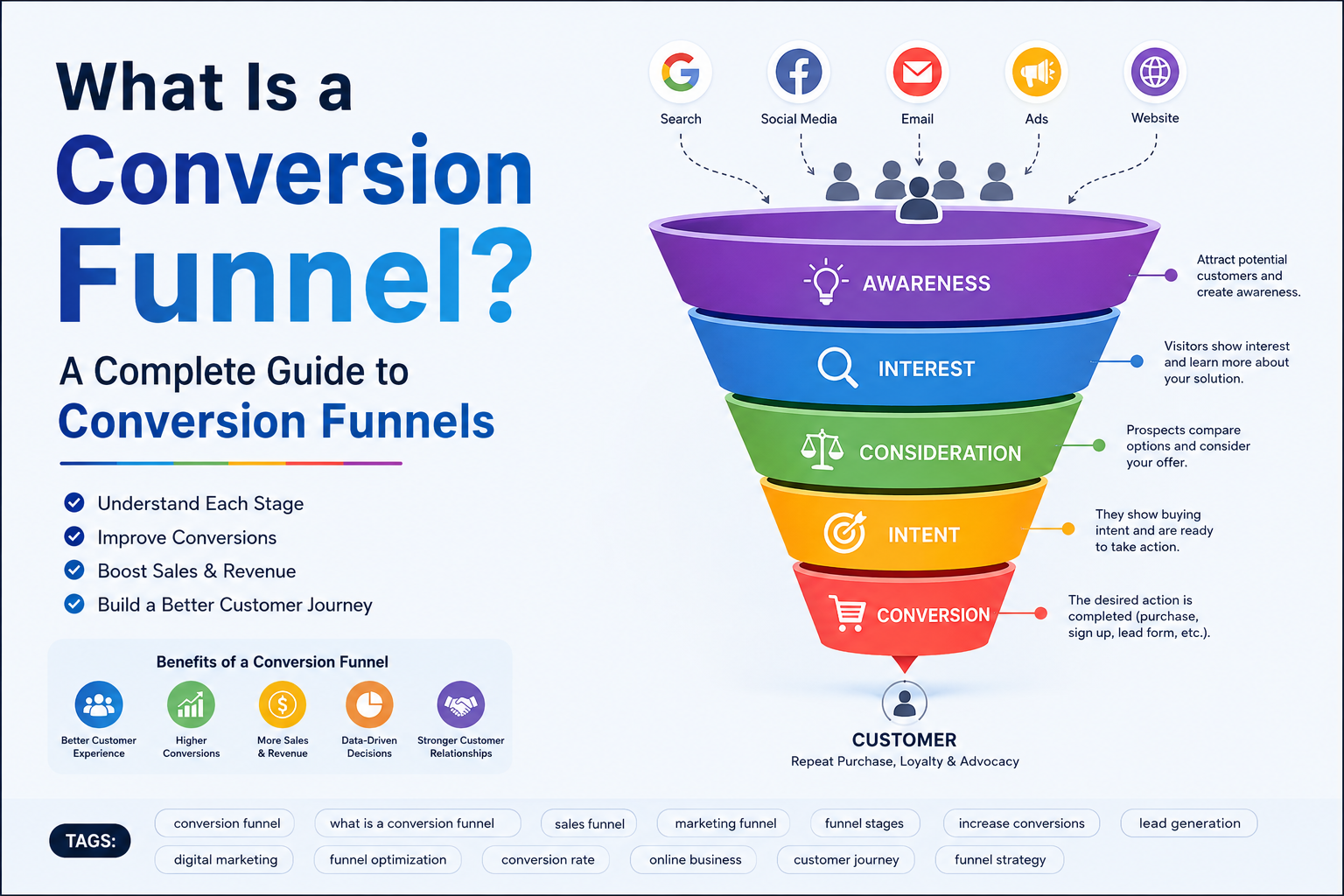

A conversion funnel is the step-by-step journey a potential customer takes from first discovering a business to completing a desired action, such as making a purchase, signing up for a service, booking a consultation, or becoming a lead. We use the concept of a conversion funnel to understand how visitors move through different stages before they convert.
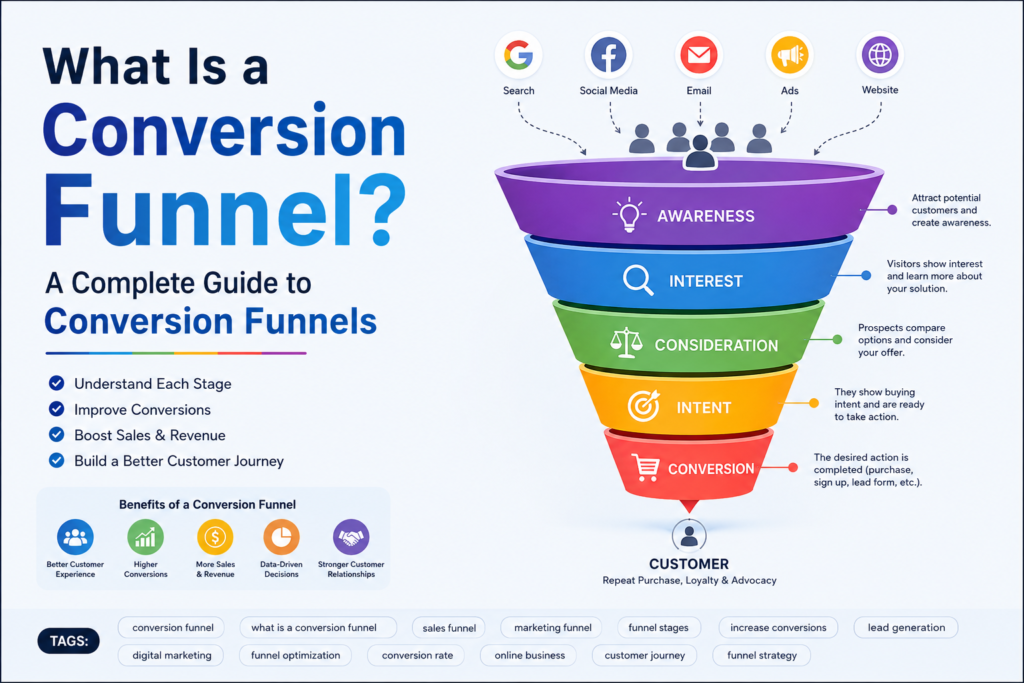
Whether we run an eCommerce store, SaaS business, affiliate website, online course, consulting business, or service company, understanding what a conversion funnel is helps us create a more effective customer journey.
A well-designed conversion funnel does more than generate sales. It helps us attract the right audience, build trust, remove objections, communicate value, and guide prospects toward the next logical step.
What Is a Conversion Funnel?
A conversion funnel is a marketing framework that represents the stages a prospect passes through before completing a conversion.
The funnel is called a “funnel” because a business may attract thousands of visitors at the beginning, while only a smaller percentage eventually become customers.
For example, we might have:
- 10,000 website visitors
- 2,000 people who engage with our offer
- 500 people who become leads
- 150 people who start a purchase
- 75 customers
At every stage, some people leave the journey while others move forward.
The goal of conversion funnel optimization is not simply to force every visitor to buy. Instead, we create a clear and persuasive journey that helps qualified prospects move naturally toward conversion.
Conversion Funnel vs. Marketing Funnel
The terms conversion funnel and marketing funnel are closely related, but they are not always used in exactly the same way.
A marketing funnel generally describes the broader customer journey, including awareness, consideration, and purchase. A conversion funnel focuses more specifically on the actions visitors take that lead toward a defined conversion.
For example, a marketing funnel may begin with someone discovering a brand through Google.
The conversion funnel could begin when that person lands on a specific landing page and continues through:
Landing page → Email signup → Product page → Checkout → Purchase
In practice, businesses often use the terms interchangeably.
How Does a Conversion Funnel Work?
A conversion funnel works by moving potential customers through a series of carefully planned steps.
Each step should have a specific purpose.
We first attract people who may have a problem or desire that our product or service can address. We then provide useful information, communicate our value proposition, establish credibility, handle objections, and present a clear call to action.
A typical conversion funnel may look like this:
Traffic → Landing Page → Lead Capture → Nurturing → Offer → Checkout → Conversion
The exact structure depends on the business model and the type of conversion we want to generate.
The Main Stages of a Conversion Funnel
1. Awareness
The first stage is awareness.
At this point, potential customers may not know much about our business. They may simply be searching for information, researching a problem, or discovering possible solutions.
We can generate awareness through:
- Search engines
- Social media
- YouTube
- Blog content
- Paid advertising
- Influencer marketing
- Referral traffic
- Online communities
- Podcasts
- Email campaigns
For example, someone searching for “how to create an online sales funnel” may discover an educational blog post.
The objective at this stage is not necessarily to make an immediate sale. Instead, we want to attract relevant visitors and introduce them to a useful solution.
2. Interest
Once visitors become aware of our brand, we need to create interest.
Visitors may start exploring our website, reading articles, watching videos, comparing products, or downloading resources.
At this stage, useful content can include:
- Tutorials
- Guides
- Case studies
- Product demonstrations
- Comparison articles
- Webinars
- Free resources
- Frequently asked questions
We should focus on answering the questions prospects are already asking.
3. Consideration
During the consideration stage, prospects understand their problem and begin evaluating potential solutions.
They may compare different companies, products, prices, features, reviews, and alternatives.
This is where strong messaging becomes particularly important.
We can help prospects make decisions by providing:
- Product comparisons
- Customer testimonials
- Reviews
- Pricing information
- Feature explanations
- Demonstrations
- Case studies
- Guarantees
- Frequently asked questions
The more uncertainty we remove, the easier it becomes for qualified prospects to move forward.
4. Intent
The intent stage occurs when a prospect demonstrates a stronger buying signal.
Examples include:
- Adding a product to a shopping cart
- Starting a free trial
- Requesting a quote
- Booking a consultation
- Signing up for a webinar
- Clicking a purchase button
- Starting checkout
At this point, we should minimize unnecessary distractions.
A clear offer, concise information, visible benefits, and a strong call to action can help prospects complete the next step.
5. Conversion
The conversion stage is where the visitor completes our desired action.
A conversion does not always mean a purchase.
Depending on the business, a conversion could be:
- Purchasing a product
- Subscribing to a service
- Creating an account
- Submitting a contact form
- Downloading an ebook
- Booking a call
- Signing up for a free trial
- Registering for an event
- Joining an email list
We should define the conversion before building the funnel because every stage needs to support that objective.
6. Retention and Repeat Conversion
A conversion funnel should not necessarily end immediately after the first conversion.
After someone becomes a customer, we can continue building the relationship through onboarding, customer support, email marketing, educational content, upsells, cross-sells, and loyalty programs.
A satisfied customer can become a repeat buyer and may eventually recommend our business to others.
Example of a Conversion Funnel
Let’s consider an example of an online course business.
The funnel might look like this:
Google Search → Blog Article → Free Course → Email Sequence → Webinar → Course Offer → Checkout → Customer
Here is how each step works.
A visitor searches Google for information about learning a particular skill. They discover our blog article and find useful information.
Inside the article, we offer a free resource.
The visitor enters their email address to receive it. We then provide useful follow-up emails that educate the subscriber and introduce our paid course.
The subscriber attends a webinar where we explain the solution in more detail.
Finally, we present the course offer and invite the subscriber to purchase.
This is a complete conversion funnel because each stage supports the next action.
Conversion Funnel Example for an eCommerce Website
An eCommerce conversion funnel may be much shorter:
Google Ad → Product Page → Add to Cart → Checkout → Purchase
We can improve this funnel by optimizing each stage.
The advertisement should match the product page.
The product page should clearly communicate benefits, pricing, specifications, reviews, shipping information, and the primary call to action.
The checkout process should be simple and trustworthy.
Reducing unnecessary steps can help prevent potential customers from abandoning their purchases.
Conversion Funnel Example for Affiliate Marketing
Affiliate marketers can also use conversion funnels.
A simple affiliate funnel might look like:
Paid Traffic → Bridge Page → Email Capture → Educational Content → Affiliate Offer → Merchant Website
Instead of immediately sending every visitor to an affiliate product, we can provide additional context and value.
For example, a visitor interested in marketing software could first arrive at an educational page explaining how sales funnels work.
We could then offer a free guide in exchange for an email address and follow up with useful information before presenting a relevant recommendation.
This approach can create more opportunities to build trust and communicate the benefits of the recommended product.
Why Conversion Funnels Matter
Conversion funnels help us understand where potential customers leave the buying journey.
Suppose 10,000 people visit a landing page but only 100 sign up.
That indicates a potential problem with the landing page, offer, targeting, or call to action.
If 1,000 people sign up but only five purchase, the problem may be further down the funnel.
Without funnel analysis, we might simply conclude that our marketing is not working.
With funnel analysis, we can identify the specific stage that requires improvement.
What Is Conversion Funnel Optimization?
Conversion funnel optimization is the process of improving each stage of a funnel to increase the percentage of visitors who complete the desired action.
We can optimize areas such as:
- Headlines
- Landing pages
- Calls to action
- Forms
- Offers
- Pricing
- Checkout pages
- Page speed
- Mobile experience
- Trust signals
- Testimonials
- Email sequences
- Product descriptions
For example, if our landing page receives significant traffic but generates very few leads, we could test a stronger headline, simplify the form, improve the offer, or make the CTA more prominent.
Important Conversion Funnel Metrics
We need measurable data to understand whether our funnel is working.
Conversion Rate
The conversion rate tells us what percentage of visitors complete a desired action.
A basic formula is:
Conversion Rate = Conversions ÷ Total Visitors × 100
For example, if 1000 people visit a landing page and 50 submit the form:
50 ÷ 1000 × 100 = 5% conversion rate
Click-Through Rate
Click-through rate (CTR) measures how many people click a link, advertisement, or call to action compared with the number of people who see it.
A low CTR may indicate that the message, offer, audience, or CTA needs improvement.
Bounce Rate
Bounce rate can help us understand whether visitors engage with a page or leave without continuing.
A high bounce rate can indicate problems with relevance, user experience, page speed, messaging, or traffic quality.
Cart Abandonment Rate
For eCommerce businesses, cart abandonment is an important metric.
Visitors may add products to their carts but leave before completing checkout.
Unexpected costs, complicated checkout processes, limited payment options, or lack of trust can contribute to abandonment.
Customer Acquisition Cost
Customer Acquisition Cost (CAC) measures how much we spend to acquire customers.
Understanding CAC helps us determine whether our funnel is financially sustainable.
How to Build a Conversion Funnel
Building a conversion funnel becomes easier when we approach it systematically.
Step 1: Define the Conversion Goal
We should first determine what we want visitors to do.
For example:
Buy a product
or
Submit a lead form
or
Start a free trial
One funnel should have a clear primary objective.
Step 2: Identify the Target Audience
We need to understand who we are trying to reach.
Important considerations include:
- Their problems
- Their goals
- Their buying motivation
- Their objections
- Their budget
- Their level of knowledge
- Their preferred communication channels
The better we understand the audience, the more relevant our funnel becomes.
Step 3: Create the Offer
A strong offer gives visitors a compelling reason to continue.
Depending on the business, the offer could include:
- Free trial
- Discount
- Free consultation
- Ebook
- Checklist
- Webinar
- Demo
- Product bundle
- Limited-time promotion
The offer should provide clear value.
Step 4: Build the Landing Page
A landing page should communicate the offer quickly.
Important elements include:
- Strong headline
- Clear value proposition
- Supporting copy
- Benefits
- Relevant visuals
- Social proof
- Testimonials
- Trust signals
- Clear CTA
We should avoid unnecessary distractions that compete with the main conversion goal.
Step 5: Create Follow-Up Sequences
Not every visitor converts immediately.
Email marketing can help us continue the conversation with prospects who are not yet ready to buy.
A useful sequence may include educational content, product information, testimonials, answers to objections, and a clear offer.
Step 6: Measure and Improve
After launching the funnel, we should monitor its performance.
We can identify where visitors are dropping off and test improvements.
This creates a continuous optimization process:
Measure → Analyze → Test → Improve → Measure Again
Common Conversion Funnel Mistakes
Even a well-designed funnel can underperform when certain mistakes are made.
Too Many Steps
A funnel with unnecessary steps can create friction.
We should remove steps that do not contribute to the customer journey.
Weak Calls to Action
Visitors should understand what action they should take next.
Instead of vague CTAs, we can use specific action-oriented language.
Poor Mobile Experience
A large percentage of online traffic comes from mobile devices.
Our landing pages, forms, checkout pages, and emails should work smoothly on smaller screens.
Lack of Trust
People are more likely to convert when they trust the business.
We can strengthen trust through testimonials, reviews, transparent pricing, guarantees, secure payment information, clear policies, and useful content.
Ignoring Existing Customers
Acquiring a customer should not be considered the final goal.
Retention, repeat purchases, referrals, and customer satisfaction can significantly increase the long-term value of a customer.
Conversion Funnel Tools
Modern funnel-building platforms can simplify the process of creating landing pages, forms, email campaigns, automation, and sales pages.
For businesses looking for an all-in-one funnel platform, Systeme.io is one option worth evaluating. It combines several marketing functions in one platform, which can be useful when we want to manage different funnel components without relying on numerous separate tools.
Other tools can also be selected depending on our specific requirements, including dedicated landing page builders, email marketing platforms, analytics systems, customer relationship management software, and eCommerce platforms.
The right technology depends on the funnel’s complexity, business model, budget, and marketing objectives.
Frequently Asked Questions About Conversion Funnels
What is a conversion funnel in simple terms?
A conversion funnel is the journey a potential customer takes from first interacting with a business to completing a desired action, such as purchasing a product, submitting a form, or signing up for a service.
What are the 4 stages of a conversion funnel?
A simplified conversion funnel can be divided into awareness, interest, consideration, and conversion. More detailed funnels may include intent, purchase, retention, and advocacy.
What is an example of a conversion funnel?
A simple example is:
Facebook Ad → Landing Page → Email Signup → Product Offer → Checkout → Purchase
Each stage is designed to move the prospect closer to the desired conversion.
What is the difference between a sales funnel and a conversion funnel?
A sales funnel generally focuses on moving prospects toward a sale, while a conversion funnel can focus on any defined conversion, including lead generation, registration, downloads, bookings, trials, or purchases.
How do we improve a conversion funnel?
We can improve a conversion funnel by analyzing performance at each stage, identifying where prospects leave, improving messaging and offers, simplifying forms and checkout, adding trust signals, testing different CTAs, and continuously measuring results.
Understanding what a conversion funnel is gives us a practical framework for turning website visitors into leads and customers.
A successful funnel does not depend on a single landing page or advertisement. It is a connected customer journey in which every stage has a clear purpose.
We attract the right audience, provide relevant information, build trust, communicate value, remove friction, and guide prospects toward the next step.
The most effective approach is to treat the funnel as an ongoing system rather than a one-time marketing campaign. By monitoring conversion rates, analyzing visitor behavior, testing different elements, and improving weak stages, we can create a funnel that becomes increasingly efficient over time.
Whether we are selling physical products, digital products, software, online courses, consulting services, or affiliate offers, a carefully designed conversion funnel can provide a structured way to turn attention into action and action into measurable business results.