
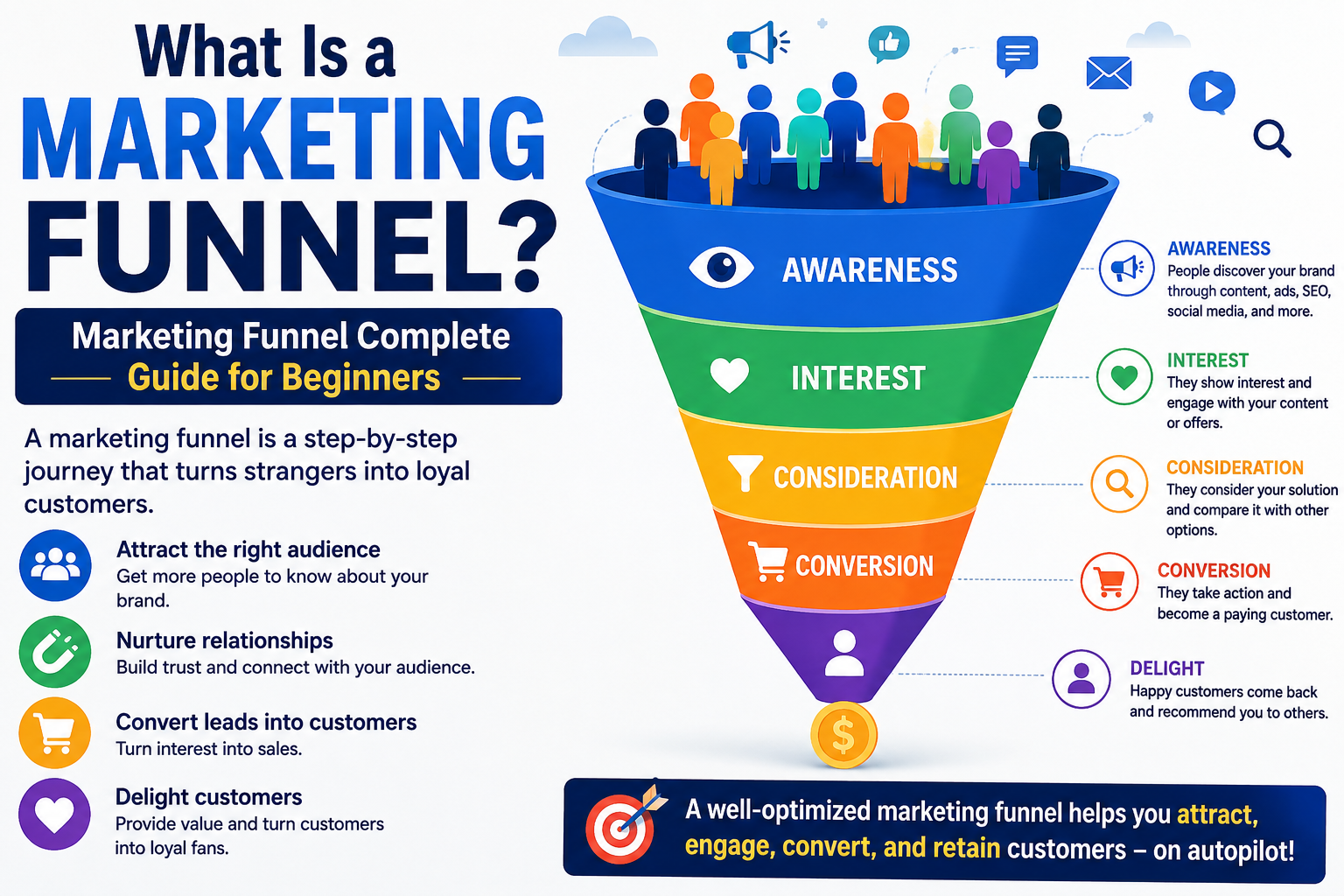

A marketing funnel is a step-by-step process that explains how potential customers move from discovering a business to becoming paying customers and, ideally, loyal customers. It helps businesses understand the customer journey and create marketing strategies for every stage of that journey.
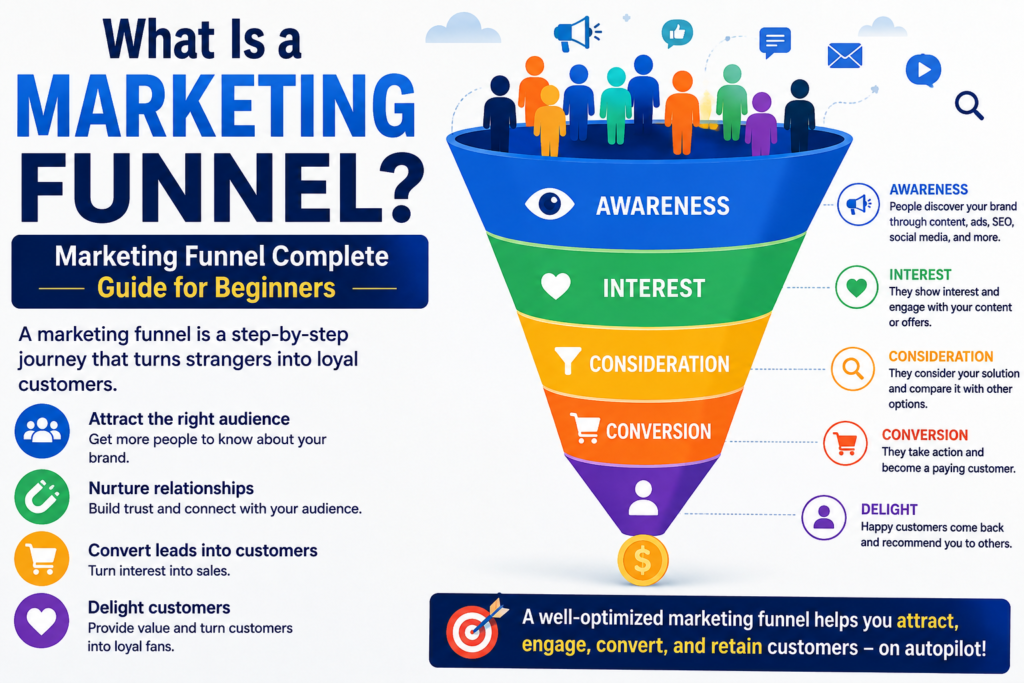
Whether we run an online store, SaaS business, consulting company, affiliate website, coaching business, or service-based business, understanding the marketing funnel can help us attract the right audience, generate leads, build trust, and increase conversions.
A typical marketing funnel can be represented as:
Awareness → Interest → Consideration → Conversion → Loyalty
In this guide, we will explain what a marketing funnel is, how it works, the different stages of a funnel, examples, benefits, and how we can create an effective marketing funnel for an online business.
What Is a Marketing Funnel?
A marketing funnel is a framework used to describe the different stages a person goes through before and after purchasing a product or service.
At the top of the funnel, we have a large number of people who may have never heard of a business. As prospects move through the funnel, some become interested, some evaluate the offer, and a smaller percentage eventually become customers.
The funnel gets narrower because not everyone who discovers a business will become a customer.
For example:
10,000 Visitors → 2,000 Leads → 500 Prospects → 100 Customers
The exact numbers will vary depending on the business, industry, offer, traffic source, and conversion strategy.
The purpose of a marketing funnel is not simply to get more visitors. It is to create a structured customer journey that moves relevant prospects toward a desired action.
Why Is a Marketing Funnel Important?
A marketing funnel helps us understand that customers rarely make a purchasing decision immediately.
Someone discovering a business through Google Search may first read a blog post. They might then visit another page, subscribe to an email list, compare alternatives, read reviews, and eventually make a purchase.
Without a funnel strategy, businesses may try to sell to visitors before those visitors understand the product or trust the brand.
A well-designed funnel allows us to provide the appropriate information at the appropriate stage.
For example:
- Awareness: Introduce the problem and brand.
- Interest: Provide useful information.
- Consideration: Explain the solution and benefits.
- Conversion: Make the purchasing process easy.
- Loyalty: Encourage repeat purchases and referrals.
The Main Stages of a Marketing Funnel
Different businesses use different funnel models. A simple marketing funnel can be divided into five major stages.
1. Awareness
The awareness stage is the top of the marketing funnel.
At this point, potential customers may not know much about our business. They may simply have a problem, question, or need.
Our goal at this stage is to attract attention and introduce our brand.
Common awareness channels include:
- Google Search
- Social media
- YouTube
- Blog content
- Paid advertising
- Podcasts
- Online communities
- Influencer marketing
- Display advertising
For example, someone searching for “how to create a sales funnel” may discover an article explaining marketing funnels.
The visitor has not necessarily decided to purchase anything. They are simply looking for information.
This is why awareness-stage content should generally focus on education and problem awareness rather than aggressive selling.
2. Interest
Once a prospect becomes aware of our business or solution, they may enter the interest stage.
Here, the prospect wants to learn more.
They may read additional articles, watch videos, subscribe to a newsletter, download a guide, or follow a social media account.
Useful content at this stage includes:
- Tutorials
- Educational videos
- Guides
- Case studies
- Webinars
- Email newsletters
- Industry reports
- Comparison articles
For example, a visitor reading about marketing funnels might then download a free funnel checklist.
This gives the business an opportunity to continue communicating with the prospect.
3. Consideration
At the consideration stage, prospects understand their problem and are actively evaluating possible solutions.
They may compare different products, read reviews, investigate pricing, or look for demonstrations.
This is where content should answer important purchasing questions.
Useful consideration-stage content includes:
- Product comparisons
- Reviews
- Case studies
- Product demonstrations
- Testimonials
- Feature comparisons
- FAQs
- Pricing information
- Detailed product guides
For example, a person considering funnel-building software may search for:
“Best marketing funnel software”
or:
“Systeme.io alternatives”
or:
“ClickFunnels vs Systeme.io”
These searches indicate stronger commercial intent than a general informational search.
4. Conversion
The conversion stage is where a prospect takes the desired action.
In many businesses, this means making a purchase. However, conversion does not always mean a sale.
A conversion could also be:
- Signing up for a free trial
- Booking a consultation
- Requesting a quote
- Registering for a webinar
- Downloading a lead magnet
- Submitting a contact form
- Creating an account
At this stage, we should remove unnecessary friction.
A strong conversion page typically includes:
- Clear headline
- Strong value proposition
- Benefits
- Relevant features
- Social proof
- Testimonials
- Clear pricing
- Strong call to action
- Simple checkout or signup process
The prospect should understand exactly what they receive and what action they need to take.
5. Loyalty and Retention
The marketing funnel should not necessarily end after a purchase.
Existing customers can become some of the most valuable people in a business’s audience.
The loyalty stage focuses on customer satisfaction, retention, repeat purchases, referrals, and advocacy.
Strategies can include:
- Customer onboarding
- Follow-up emails
- Educational content
- Loyalty programs
- Exclusive offers
- Customer support
- Product recommendations
- Referral programs
- Customer communities
A satisfied customer may purchase again or recommend the business to someone else.
This creates another source of growth.
Marketing Funnel Example
Let’s look at a simple example of a marketing funnel for an online software business.
Step 1: Attract Visitors
The business publishes an SEO article called:
“How to Build a Marketing Funnel for Beginners.”
A potential customer discovers the article through Google.
Step 2: Capture the Lead
The article offers a free downloadable funnel checklist.
The visitor enters their email address to receive it.
Step 3: Nurture the Lead
The business sends a series of educational emails explaining:
- How marketing funnels work
- Common funnel mistakes
- Landing-page optimization
- Email automation
- Conversion strategies
Step 4: Present the Product
After providing useful information, the business introduces its funnel-building software.
Step 5: Convert the Prospect
The prospect starts a free trial or purchases a subscription.
Step 6: Retain the Customer
The company provides onboarding emails, tutorials, customer support, and additional resources.
This creates a complete customer journey rather than relying on a single advertisement or sales page.
Marketing Funnel vs Sales Funnel
The terms marketing funnel and sales funnel are often used interchangeably, but there can be an important distinction.
A marketing funnel generally covers the broader process of attracting and nurturing potential customers.
A sales funnel tends to focus more specifically on moving prospects toward a purchase.
A simplified model is:
Marketing Funnel:
Awareness → Interest → Education → Consideration
Sales Funnel:
Qualified Lead → Offer → Objection Handling → Purchase
In many modern businesses, these two processes overlap significantly.
What Is a Digital Marketing Funnel?
A digital marketing funnel uses online channels to move prospects through the customer journey.
For example:
Google Search → Blog Post → Landing Page → Email List → Product Demo → Purchase
Digital funnels can use multiple traffic sources and automated communication systems.
Common digital marketing funnel channels include:
- SEO
- Google Ads
- Social media
- Email marketing
- Content marketing
- YouTube
- Affiliate marketing
- Display advertising
- Influencer marketing
One advantage of digital funnels is that many parts of the process can be measured and automated.
What Is a Sales Funnel Builder?
A sales funnel builder is software that allows businesses to create different stages of a funnel without building everything from scratch.
Depending on the platform, funnel-building software may include:
- Landing-page builders
- Forms
- Email marketing
- Automation
- Checkout pages
- Payment integration
- Upsells
- Analytics
- CRM functionality
- Membership features
Popular funnel-building platforms include Systeme.io, ClickFunnels, Leadpages, and other marketing automation platforms.
The right tool depends on the business model and funnel requirements.
What Is a Lead Funnel?
A lead funnel is designed primarily to convert visitors into leads.
A lead is usually someone who provides contact information, such as an email address or phone number, and gives the business permission to continue communicating with them.
A simple lead funnel might look like:
Traffic → Landing Page → Lead Magnet → Email Signup → Email Sequence → Offer
Common lead magnets include:
- Free ebooks
- Checklists
- Templates
- Tutorials
- Coupons
- Free consultations
- Webinars
- Free trials
- Calculators
- Reports
The goal is to exchange something valuable for the prospect’s contact information.
What Is a Marketing Funnel for Affiliate Marketing?
Affiliate marketers can also use marketing funnels to guide visitors toward affiliate offers.
A typical affiliate funnel could be:
Traffic Source → Content or Bridge Page → Email Capture → Follow-Up Emails → Affiliate Offer
For example, an affiliate marketer promoting marketing software could create an educational article explaining how sales funnels work.
The article could invite readers to download a free funnel checklist. After subscribing, the visitor receives useful educational emails before being introduced to a relevant software product.
This approach can be more effective than sending every visitor directly to an affiliate offer.
How to Create a Marketing Funnel
Creating a marketing funnel becomes easier when we approach it systematically.
Step 1: Define the Target Audience
First, determine who the funnel is designed for.
We should understand:
- Their problems
- Their goals
- Their buying motivations
- Their objections
- Their budget
- Their preferred communication channels
A specific audience usually produces a more relevant funnel.
Step 2: Define the Goal
Every funnel should have a clear objective.
For example:
Generate leads → Book calls → Sell products → Start free trials → Increase subscriptions
Avoid creating a funnel without knowing what action we want visitors to take.
Step 3: Choose a Traffic Source
We need to determine how potential customers will enter the funnel.
Possible sources include:
- SEO
- Google Ads
- Facebook Ads
- YouTube
- Affiliate traffic
- Social media
Step 4: Create a Lead Magnet or Valuable Entry Point
If visitors are not ready to purchase, give them a reason to continue the relationship.
A useful lead magnet can help turn anonymous traffic into identifiable leads.
Step 5: Build a Landing Page
The landing page should have one primary objective.
A strong landing page can include:
Headline → Problem → Solution → Benefits → Proof → CTA
The fewer distractions we have, the easier it becomes for visitors to understand the next step.
Step 6: Add Email Automation
Email automation allows us to follow up with leads automatically.
For example:
Day 1: Deliver the resource
Day 2: Educational email
Day 4: Common mistakes
Day 6: Case study
Day 8: Product introduction
Day 10: Special offer
The exact sequence should match the audience and buying cycle.
Step 7: Measure Funnel Performance
Important metrics include:
- Traffic
- Landing-page conversion rate
- Lead conversion rate
- Email open rate
- Email click-through rate
- Sales conversion rate
- Customer acquisition cost
- Average order value
- Return on advertising spend
- Customer lifetime value
These numbers help us identify where prospects are dropping out.
Common Marketing Funnel Mistakes
Trying to Sell Too Early
Not every visitor is ready to purchase immediately. Educational content and trust-building can be important for prospects who are still researching.
Using Too Many Calls to Action
A landing page with several competing CTAs can create confusion.
A clear primary action usually creates a more focused customer journey.
Ignoring Mobile Visitors
A funnel that works well on desktop but poorly on mobile can lose potential customers.
Every major funnel page should be tested across different screen sizes.
Not Following Up With Leads
Capturing an email address without having a follow-up strategy means a significant opportunity may be lost.
Email automation can keep the conversation going after the initial interaction.
Not Testing the Funnel
A funnel should be improved over time.
We can test:
- Headlines
- CTA text
- Images
- Forms
- Offers
- Pricing
- Page layouts
- Email subject lines
Small improvements at different funnel stages can have a meaningful impact on overall performance.
Benefits of Using a Marketing Funnel
A well-designed marketing funnel can help businesses:
- Generate more qualified leads
- Improve conversion rates
- Build relationships with prospects
- Automate repetitive marketing tasks
- Understand customer behavior
- Improve advertising efficiency
- Increase sales
- Improve customer retention
- Create a predictable customer journey
Instead of treating marketing as a collection of disconnected activities, a funnel connects each activity into one structured process.
Frequently Asked Questions
What is a marketing funnel in simple words?
A marketing funnel is the journey a potential customer takes from discovering a business to becoming a customer. It commonly includes awareness, interest, consideration, conversion, and retention.
What are the 5 stages of a marketing funnel?
A commonly used five-stage model is awareness, interest, consideration, conversion, and loyalty.
What is an example of a marketing funnel?
A simple example is Google Search → Blog Post → Lead Magnet → Email Sequence → Product Offer → Purchase.
Why is a marketing funnel important?
A marketing funnel helps businesses understand customer behavior and create targeted marketing activities for different stages of the buying journey.
Is a marketing funnel only for online businesses?
No. Physical stores, professional services, B2B companies, agencies, restaurants, education businesses, and many other organizations can use funnel principles.
What is the difference between a marketing funnel and a sales funnel?
A marketing funnel generally covers the broader customer journey from awareness through conversion and retention, while a sales funnel often focuses specifically on progressing qualified prospects toward a purchase.
A marketing funnel provides a structured way to understand how people discover a business, become interested, evaluate an offer, make a purchase, and potentially become repeat customers.
The most effective funnels are built around the customer’s needs rather than simply pushing a product. By combining useful content, targeted traffic, landing pages, lead generation, email marketing, persuasive offers, and ongoing optimization, we can create a customer journey that is easier to understand and improve.
Whether we are building an ecommerce business, SaaS company, affiliate website, coaching business, agency, or online service, understanding what a marketing funnel is gives us a strong foundation for creating a more organized and measurable digital marketing strategy.